
1.1 What is Front Desk Operations?
Front Desk Operations refer to the wide range of activities, responsibilities, and services carried out by personnel who serve as the first point of contact for clients, customers, or visitors. This can happen physically at a reception area or virtually through digital platforms such as emails, live chats, and phone calls.
The front desk plays a very important role in every organization. These professionals are often described as the face and voice of the company because they create the very first impression people have when they walk in or make contact. The way they welcome, attend, and respond to inquiries sets the tone for how the public perceives the entire organization.
✔️ Why is this important?
The front desk reflects the level of professionalism, hospitality, and service quality of the organization. A friendly, well-trained front desk officer leaves visitors feeling valued and respected, while poor handling can damage trust and reputation.
✔️ What does this mean for you?
As a front desk professional, your role is more than just sitting at a desk—you are the bridge between the public and the organization. Your efficiency, communication skills, and positive attitude can directly influence customer satisfaction, loyalty, and the overall image of the organization.
In simple terms, Front Desk Operations is not just about answering calls or greeting people—it is about managing the first impression, creating a welcoming environment, and ensuring smooth communication between the organization and those it serves.
A Day in the Life of Chinedu – A Nigerian Front Desk Professional Abroad
Chinedu, a Nigerian who recently began working as a front desk officer in a healthcare facility in the UK, starts his day with a smile. For him, every morning is an opportunity to represent not just his organization, but also his personal values of respect and hospitality.
Morning Routine (8:00 AM – 10:00 AM)
Chinedu arrives 15 minutes early to prepare the reception area. He powers up the computer system, checks the day’s appointment schedule, and ensures the waiting area is neat and welcoming. By 8:30 AM, patients begin to arrive. He greets each one warmly:
> “Good morning, welcome. May I have your name for check-in, please?”
His polite tone and calm demeanor immediately put people at ease, especially those nervous about seeing a doctor.
Mid-Morning Rush (10:00 AM – 12:30 PM)
The phones ring continuously, emails come in with appointment queries, and walk-in patients request information. Chinedu skillfully multitasks—logging visitor details, answering questions, and redirecting calls to the right departments. At one point, a frustrated visitor arrives late for an appointment and raises his voice. Chinedu keeps calm, empathizes with the visitor’s frustration, and offers an alternative slot. The visitor leaves satisfied, and the waiting room atmosphere remains peaceful.
Afternoon Responsibilities (1:30 PM – 4:00 PM)
After a quick lunch, Chinedu returns to handle deliveries, update patient records, and confirm the next day’s appointments. He also provides basic information to new patients about the facility’s procedures. A VIP guest—a board member—arrives for a meeting, and Chinedu immediately switches to a more formal tone, offering refreshments and escorting the guest to the right office. His ability to adapt to different types of visitors is one of his strongest skills.
Late Afternoon (4:00 PM – 5:30 PM)
As the day winds down, Chinedu prepares an end-of-day log, recording the number of visitors and summarizing any issues that need follow-up. He confirms that the next day’s appointment list is accurate and tidy. Before leaving, he makes sure the reception area is clean, organized, and ready for the next day.
End of the Day Reflection
Walking home, Chinedu reflects on the day. He is proud of how he managed a difficult visitor, supported patients with empathy, and represented his organization well. For him, being a front desk officer abroad is not just a job—it’s about bridging cultures, creating positive first impressions, and leaving people with a sense of dignity and respect.
✔️ Training Insight:
Chinedu’s day shows learners that front desk operations are about more than tasks—they are about patience, adaptability, and professionalism. Every interaction is a chance to shape how people experience the organization.
1.2 Key Roles of Front Desk Operations
The front desk is not just a table at the entrance—it is the nerve center of customer interaction. Every action taken at the front desk reflects on the organization. Below are the key roles that front desk operations usually cover:
✔️ Greeting and Welcoming Guests or Clients
The way you greet a visitor sets the tone for the entire interaction. A warm smile, polite words, and attentive attitude create a sense of comfort and trust from the very first moment.
✔️ Handling Inquiries and Complaints (in person, on the phone, or via email)
Front desk staff are expected to answer questions and resolve complaints in a calm, professional manner. The ability to listen carefully, provide accurate information, and remain polite—even when faced with difficult customers—is one of the most important skills.
✔️ Managing Bookings, Appointments, or Reservations
Many organizations rely on their front desk to schedule meetings, confirm appointments, or make reservations. This requires excellent organizational skills and attention to detail to avoid errors and delays.
✔️ Directing Visitors to Appropriate Departments or Personnel
As the “traffic controller” of the office, the front desk ensures that visitors and inquiries are guided to the right place without confusion. This saves time and improves efficiency within the organization.
✔️ Maintaining Front Office Records and Managing Documentation
From visitor logs to appointment books and digital records, proper documentation ensures smooth follow-up and accountability. Keeping accurate records is a key responsibility of the front desk.
✔️ Providing Basic Information about Services, Products, or Policies
Front desk staff often act as the first “information desk.” They must know the basics about the organization’s services, products, and policies to confidently respond to common questions.
✔️ Ensuring the Front Desk Area is Clean, Organized, and Presentable
The appearance of the front desk is a silent communicator. A clean, tidy, and professional environment sends a positive message about the organization’s values and standards.
👉 As you can see, the role of the front desk goes beyond simply “being there.” It requires organization, communication, patience, and professionalism to ensure that both the organization and its visitors have a smooth experience.
1.3 Job Titles Commonly Associated with Front Desk Operations
As you prepare for a career in front desk operations, it’s important to know that your job title may differ depending on the industry or organization you work with. Even though the responsibilities are often similar, the titles may vary. Some of the common ones you may come across include:
✔️ Receptionist – The most widely used title, usually found in offices, schools, clinics, and hotels.
✔️ Front Desk Officer – A professional title that emphasizes your role as the first point of contact.
✔️ Guest Service Agent – Commonly used in the hospitality industry, especially hotels and resorts.
✔️ Customer Service Representative – Focuses on client interaction, problem-solving, and support (both in-person and online).
✔️ Administrative Assistant – A broader role that includes front desk duties as well as office support tasks.
✔️ Client Relations Officer – A title that highlights building and maintaining positive relationships with clients.
👉 As you can see, no matter the title, your core responsibility remains the same—representing the organization professionally and managing first impressions.
1.4 Industries Where Front Desk Operations Are Essential
Front desk professionals are needed in almost every industry. Wherever people interact with organizations, someone has to be there to welcome, guide, and provide assistance. Here are some key sectors where your skills will always be in demand:
✔️ Hospitality (Hotels, Resorts, and Lodges)
You may handle check-ins, check-outs, reservations, and ensure guests feel at home throughout their stay.
✔️ Healthcare (Hospitals and Clinics)
Front desk staff here help patients with registration, appointment scheduling, and answering medical inquiries—often under pressure.
✔️ Corporate Offices
As the first point of contact for visitors, job applicants, and business partners, you set the tone for the company’s professional image.
✔️ Education (Schools and Universities)
You may be responsible for assisting students and parents, maintaining records, and providing administrative support.
✔️ Aviation and Travel (Airlines and Travel Agencies)
In this sector, front desk staff manage ticketing, travel inquiries, boarding assistance, and customer complaints.
✔️ Public Service & Government Agencies
You may assist citizens with their questions, appointments, and service redirection, ensuring smooth delivery of public services.
💡 Key takeaway for you: No matter the industry, the front desk is the heartbeat of customer interaction. By mastering these skills, you position yourself to work in a variety of fields, giving you flexibility and wider career opportunities.
1.5 A Brief History of Front Desk Operations
The role of the front desk has been around for much longer than you may think. While technology and job titles have changed over time, the core responsibility—welcoming and assisting people—has always remained the same.
✔️ Early Beginnings (Hospitality Roots)
The concept of the “front desk” can be traced back to early inns and guest houses, where innkeepers or attendants greeted travelers, managed room bookings, and ensured guests were comfortable. This was the foundation of what we now call hospitality front desk operations.
✔️ The Rise of Offices and Administration
As businesses and government offices expanded in the 19th and 20th centuries, organizations needed a designated person to greet visitors, handle correspondence, and manage records. This gave rise to the role of the receptionist—someone who was always available at the entrance to represent the organization.
✔️ Introduction of Telephones and Technology
With the invention of the telephone, the front desk took on even greater importance. Receptionists became responsible not only for in-person visitors but also for handling calls, taking messages, and connecting people to the right departments. This added a new level of professionalism to the role.
✔️ Modern Evolution
Today, front desk operations go beyond physical spaces. With digital platforms, emails, live chats, and virtual customer service, the role has expanded into both in-person and online interactions. Modern front desk professionals are trained in communication, technology, and customer service, making the role more dynamic than ever.
💡 Why this matters for you:
As you train in front desk operations, you are stepping into a profession with a rich history. From inns and offices of the past to today’s global businesses and digital platforms, front desk professionals have always been the face and voice of organizations. Your role is part of a long tradition of hospitality, service, and professionalism.

Amaka, a Nigerian working as a front desk officer in a Canadian hotel, takes pride in her job. Every day, she reminds herself that she is not just the first smile guests see—she is also the first line of security for the organization.
It was a chilly Wednesday afternoon, and the hotel lobby was busy. Guests were checking out, families were asking for directions, and the phones were ringing nonstop. Despite the bustle, Amaka stayed calm, greeting everyone with her signature warmth.
Just then, she noticed a man in a delivery uniform walk briskly through the lobby carrying a large package. He didn’t stop at the desk and headed straight for the elevators. Something about it didn’t sit right with her—hotel policy was clear: every visitor must register at the front desk before entering any floor.
“Excuse me, sir,” Amaka called out, keeping her voice firm but polite. The man stopped, looking slightly irritated.
> Delivery man: “I’ve got a package for Room 704. I’m in a hurry, I’ve done this before. Just let me through—it’ll only take a minute.”
Amaka smiled, but her tone carried authority:
> Amaka: “I completely understand, sir, and I’ll make sure this is quick. But for security reasons, everyone—including delivery staff—must be logged in and issued a visitor badge. Let me confirm your delivery with the guest first, and then you’ll be on your way.”
The delivery man frowned, muttering under his breath, but Amaka remained calm. She had been trained never to argue or escalate, but also never to bend rules when it came to safety. She quickly called Room 704. The guest confirmed they were expecting a delivery. With that confirmation, Amaka logged the man into the visitor system, issued him a badge, and gave him clear instructions on where to go.
> Amaka (with a smile): “Thank you for your patience. Here’s your visitor badge. The elevators are just ahead. Have a great day.”
The delivery man nodded, a little less grumpy now, and proceeded upstairs.
Later that evening, the hotel manager heard about the incident and praised Amaka for her diligence. “You handled that perfectly,” he said. “You enforced security without being rude, and you made sure the guest received their delivery safely. That’s exactly what we need at the front desk.”
As Amaka closed her shift, she felt proud. Being a front desk officer abroad wasn’t always easy—she had to balance cultural expectations, strict policies, and customer service—but she knew one thing: her professionalism and commitment to safety made a real difference every single day.
✔️ Training Insight:
Amaka’s story shows that enforcing security isn’t about being harsh—it’s about being firm, respectful, and solution-oriented. A good front desk officer prevents risks while still making people feel valued and respected.
1.3 Key Responsibilities and Qualities of a World-Class Front Desk Officer
To excel as a front desk professional in today’s world, you need more than just basic skills—you must display the right qualities and responsibilities that make you globally competent. These are the traits that set apart an ordinary front desk officer from a world-class professional.
Let’s break them down:
✔️ 1. Politeness
⭐ Always remain calm, respectful, and welcoming—even when under pressure.
⭐ A polite attitude immediately puts visitors at ease and creates a lasting positive impression.
✔️ 2. Organizational Skills
⭐ Manage your time, calls, schedules, and appointments efficiently.
⭐ Good organization ensures nothing is missed, delayed, or forgotten.
✔️ 3. Multi-tasking Ability
⭐ Handle multiple responsibilities—such as greeting visitors, answering phones, and managing bookings—without losing composure.
⭐ Multi-tasking shows your ability to stay in control even during busy hours.
✔️ 4. Professionalism
⭐ Always maintain ethical standards, honesty, and integrity in your work.
⭐ Carry yourself with a composed demeanor, whether dealing with senior executives or first-time visitors.
✔️ 5. Technical Know-how
⭐ Be familiar with tools such as booking systems, Customer Relationship Management (CRM) software, and communication platforms.
⭐ Technology makes your job easier, but you must know how to use it effectively.
✔️ 6. Cultural Sensitivity
⭐ Respect diversity by being open and adaptable to people from different cultural, religious, or social backgrounds.
⭐ In a global world, cultural sensitivity helps you avoid misunderstandings and ensures everyone feels valued.
✔️ 7. Problem-Solving Skills
⭐ Handle complaints or confusing situations tactfully, without panic or defensiveness.
⭐ Customers value front desk officers who can provide solutions rather than excuses.
💡 Key takeaway for you: A world-class front desk officer is not only polite and professional but also organized, adaptable, and solution-driven. These qualities make you stand out in any industry and open doors for global opportunities.
1.3.2. Daily Routine at the Front Desk (Global Best Practices)
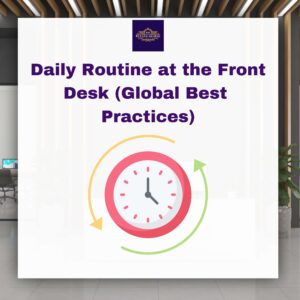
As a front desk officer aiming for global standards, your day should follow a structured flow like this:
⭐ 7:30 AM – 8:00 AM → Arrive early, check the cleanliness of your station, and review handover notes.
⭐ 8:00 AM – 10:00 AM → Greet guests warmly, process early arrivals, and attend to phone calls promptly.
⭐ 10:00 AM – 12:00 PM → Schedule meetings, update records, and sort incoming or outgoing mail.
⭐ 12:00 PM – 2:00 PM → Hand over for lunch break, confirm appointment statuses, and report any issues to the right channel.
⭐ 2:00 PM – 5:00 PM → Attend to walk-in visitors, prepare the daily summary, and brief your supervisor.
1.4. Skills Required for Front Desk Success
Think of the front desk as the heartbeat of any organization—it’s the first place people see, the first voice they hear, and often the experience they remember most. To truly shine in this role, you need more than just a friendly smile. Success comes from blending people skills, professional habits, and a good dose of technical know-how. Whether it’s calming a frustrated guest, keeping appointments running smoothly, or quickly learning new systems, these skills make the difference between being a good front desk officer and a world-class one.
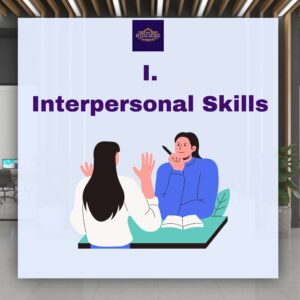
Interpersonal Skills
At the front desk, people are your world. Every smile, every word, and every little gesture sets the tone for how clients, visitors, or guests feel about the entire organization. This is more than just saying “hello” — it’s about creating a lasting impression. Interpersonal skills help you build trust, calm tense situations, and leave people feeling valued.
Here’s how you can shine:
⭐ Display warmth and friendliness – A warm smile, good eye contact, and a cheerful greeting make people feel welcome instantly. Even a small “Good morning, how can I help you today?” can ease tension and set a positive mood.
⭐ Show empathy and patience – Sometimes, people approach the desk upset, confused, or even angry. By listening carefully, acknowledging their feelings (“I understand this must be frustrating”), and responding calmly, you not only solve their issue but also win their respect.
⭐ Handle difficult situations diplomatically – You’ll often face complaints, delays, or misunderstandings. The key is to remain calm, avoid taking it personally, and focus on solutions. Diplomacy means choosing words carefully, keeping your tone polite, and ensuring the person feels heard, even when you cannot meet every request.
⭐ Adapt to different personalities – Every individual is unique: some are chatty, some are quiet, others may be demanding. The ability to read body language and adjust your approach — formal, casual, or empathetic — is what makes you stand out as a professional.
⭐ Create a positive atmosphere – Beyond problem-solving, your attitude can influence the entire workplace. A friendly, approachable demeanor encourages open communication and makes both guests and colleagues comfortable.
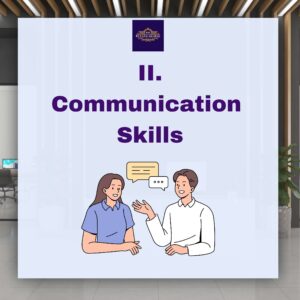
Communication Skills
As the first point of contact, the front desk professional is the voice and face of the organization. Clear, confident, and respectful communication creates trust and sets the tone for every interaction. Strong communication skills help ensure information flows smoothly, problems are resolved quickly, and visitors leave with a positive impression.
Here’s how to master it:
⭐ Speak clearly, politely, and confidently – Your tone of voice should always reflect professionalism. Avoid mumbling or sounding rushed; instead, speak at a steady pace with warmth and confidence. Words like “please,” “thank you,” and “you’re welcome” go a long way in showing respect.
⭐ Listen actively and respond appropriately – Good communication is not just about speaking — it’s about understanding. Pay full attention, avoid interrupting, and use affirming nods or short verbal cues (“I see,” “I understand”). After listening, provide accurate and helpful responses to show the person that their concerns matter.
⭐ Use professional language in written communication – Front desk professionals often send emails, memos, or instant messages. These should always be concise, free of slang, and respectful in tone. Correct grammar and spelling reflect competence and leave a strong impression of the organization’s professionalism.
⭐ Maintain positive body language and eye contact – Non-verbal communication can be more powerful than words. Smiling, standing tall, avoiding crossed arms, and making eye contact demonstrate openness and confidence. These signals make people feel welcomed and respected, even before you speak.
⭐ Adapt communication style to the audience – Whether you’re speaking with a manager, a colleague, or a first-time visitor, adjust your tone and vocabulary to match the situation. A flexible communicator can switch from formal to friendly without losing professionalism.

Multitasking Ability
The front desk is the control center of the organization, often buzzing with phone calls, visitors, and administrative tasks happening all at once. A successful front desk professional must remain calm, organized, and efficient while handling multiple responsibilities simultaneously. The goal is to manage competing demands without compromising on professionalism or service quality.
Here’s how to build strong multitasking skills:
⭐ Answer phones while attending to walk-in visitors – When faced with both, acknowledge the visitor with a smile or polite gesture while courteously handling the call. Prioritize clarity and brevity on the phone, so neither party feels ignored.
⭐ Manage check-ins and check-outs simultaneously – Whether in a hotel, hospital, or office setting, professionals must process arrivals and departures with accuracy. Using systems effectively, maintaining focus, and keeping documents ready ensures a smooth flow without delays.
⭐ Handle inquiries while processing documents or making calls – Distractions are common, but multitasking should never lead to mistakes. Use short pauses to acknowledge inquiries and let people know you’ll attend to them shortly. Develop the ability to switch tasks seamlessly while staying attentive to details.
⭐ Stay calm under pressure – Multitasking is not about rushing; it’s about prioritizing. Knowing which task requires immediate attention helps maintain balance and avoid errors, even in high-pressure moments.
⭐ Use tools to stay organized – From appointment calendars to digital reminders, organizational tools help professionals manage multiple tasks more efficiently. Well-structured systems make multitasking smoother and reduce the risk of oversight.

Professional Appearance
First impressions matter—especially at the front desk. Before a visitor hears your voice or experiences your service, they notice how you present yourself. A neat, professional appearance instantly communicates credibility, competence, and respect for the organization you represent. Remember, you are the face of the company, and your look sets the tone for how people perceive the entire workplace.
Here’s how to maintain a professional appearance that builds trust:
⭐ Dress according to the organization’s dress code or a business-professional standard – Whether it’s a uniform, business attire, or smart casual, consistency matters. Dressing neatly shows that you respect your role and are prepared to represent the organization in the best light.
⭐ Maintain personal hygiene and grooming – Freshness, tidy hair, clean nails, and polished shoes all send the message that you pay attention to details. Visitors often notice the little things, and these habits reflect directly on the professionalism of the company.
⭐ Wear a welcoming smile—it’s part of the uniform! – A smile is a simple but powerful tool. It makes visitors feel at ease, projects warmth, and creates a positive atmosphere in the reception area. Think of it as a non-verbal “hello” that invites people to feel welcome.
⭐ Keep accessories minimal and professional – Jewelry, makeup, or fragrances should never be distracting. Subtle and tidy choices enhance professionalism without pulling focus away from your role.
⭐ Project confidence through posture and body language – Standing or sitting upright, maintaining eye contact, and appearing attentive all add to your professional image. The way you carry yourself can often say more than what you wear.

Time Management
In a front desk role, time is one of your most valuable resources. Every minute counts—whether you’re scheduling appointments, answering calls, or assisting visitors. A strong sense of time management not only keeps operations running smoothly but also reduces stress and ensures that no detail slips through the cracks. Being punctual and organized shows reliability, and it reassures both colleagues and clients that they can count on you.
Here are some key ways to master time management at the front desk:
⭐ Schedule appointments and follow through – Use calendars, scheduling software, or appointment books to stay on top of meetings and commitments. Double-check times and send reminders where necessary to prevent overlaps or no-shows.
⭐ Keep records up to date and easily accessible – Organized files (digital or physical) save precious minutes when information is needed quickly. Proper record-keeping also prevents mistakes and helps provide accurate responses to inquiries.
⭐ Prioritize tasks to avoid bottlenecks during peak periods – Some tasks can wait, but others require immediate attention. Learn to distinguish between urgent and important responsibilities so you can handle busy periods without missing deadlines.
⭐ Stay punctual yourself – Arriving on time and keeping to schedules sets the standard for everyone else. It also shows respect for visitors’ and colleagues’ time.
⭐ Use productivity tools wisely – From digital reminders to task lists, these tools can help you manage workload effectively. The key is discipline—don’t just set reminders, act on them.

Technology Proficiency
Today’s front desk is more than just a physical space—it’s a digital hub that connects the organization with the outside world. Modern front desk professionals must be tech-savvy and adaptable, as technology is woven into almost every aspect of the role. Being proficient with tools and systems not only boosts efficiency but also positions you as a resourceful and dependable member of the team.
Here’s what strong technology proficiency looks like at the front desk:
⭐ Operate office software – Comfortably use applications like Microsoft Office (Word, Excel, PowerPoint), Google Workspace (Docs, Sheets, Drive), and Customer Relationship Management (CRM) systems to manage data, prepare reports, and keep operations running smoothly.
⭐ Use email and messaging tools professionally – Whether responding to clients, circulating memos, or engaging with colleagues, your communication should be timely, clear, and professional across platforms like Outlook, Gmail, Teams, or Slack.
⭐ Handle office equipment with confidence – From telephone systems to printers, copiers, and scanners, you should be able to troubleshoot minor issues and ensure these tools support smooth daily operations.
⭐ Leverage visitor management tools – Many modern organizations use digital check-in systems, ID badge printers, and security software. Being skilled with these tools helps streamline visitor experiences while maintaining security.
⭐ Adapt quickly to new platforms – Technology evolves rapidly. A successful front desk professional is always open to learning new apps, booking systems, or productivity tools without hesitation.
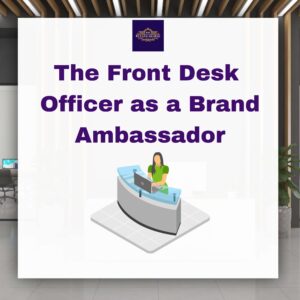
1.5 The Front Desk Officer as a Brand Ambassador
A front desk officer is far more than just a receptionist or a gatekeeper—they are the living, breathing representation of the organization’s brand. Every smile, every word, and every action communicates something about the company’s values, culture, and professionalism. In fact, for many visitors, clients, or even new employees, the front desk officer is the first person they interact with—and that interaction often defines their perception of the entire organization.
Think of it this way: before a visitor meets a manager or sees the quality of a product or service, they have already experienced your brand through the front desk. That’s why this role isn’t just operational—it’s strategic.
Why this matters
✅ A courteous greeting sets the tone for the entire customer experience, creating a welcoming environment before business even begins.
✅ A helpful and proactive attitude builds trust, eases tension, and reassures visitors that they’re in good hands.
✅ A disorganized or indifferent demeanor can create frustration, diminish trust, and sometimes leave a negative impression that overshadows the organization’s strengths.
Ultimately, a great front desk officer doesn’t just “represent” the brand—they embody it. By aligning their words, appearance, and behavior with the organization’s values, they become true brand ambassadors, ensuring that every interaction strengthens the company’s image.
Mr. Johnson, a potential investor, walks into the reception area of Sunrise Holdings Ltd. with
high expectations. He has heard about the company’s professionalism and is eager to explore a
possible partnership.
At the front desk sits Bolanle, the front desk officer. Instead of greeting him warmly, Bolanle is
slouched in her chair, scrolling through her phone. She barely looks up when Mr. Johnson
enters.
“Good morning,” Mr. Johnson says with a polite smile.
Without making eye contact, Bolanle mutters, “Yes, what do you want?”
The lack of courtesy immediately unsettles him. He explains that he has a 10 a.m. appointment
with the Managing Director. Bolanle frowns, rummages through a disorganized pile of papers,
and sighs loudly.
“I don’t see your name here. Are you sure you have an appointment?” she asks in a dismissive
tone.
Mr. Johnson, now visibly uncomfortable, offers to show the email confirmation on his phone.
Instead of checking it carefully, Bolanle waves her hand impatiently and says, “Just sit down, I’ll
check later.”
He sits in the waiting area for nearly 20 minutes with no updates. The receptionist conƟnues
chatting on her phone, laughing loudly, while visitors glance at each other uncomfortably. When
finally approached by a staff member from another department, it becomes clear that Bolanle
had overlooked the appointment on her messy log sheet.
By the time Mr. Johnson is ushered in to meet the Managing Director, he already feels neglected
and disrespected. Though the meeting goes well, the damage has been done—the poor first
impression at the front desk leaves him doubting the company’s professionalism.
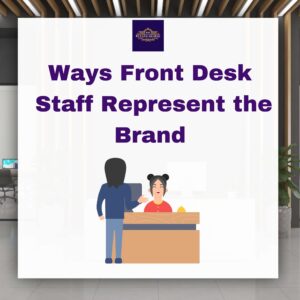
Ways Front Desk Staff Represent the Brand
The front desk is more than a reception point—it is the face and voice of the organization. Every
word spoken, gesture made, and action taken communicates something about the company’s
values and culture. This is why front desk professionals must always carry themselves as brand
ambassadors.
Here are key ways front desk staff reflect and reinforce the organization’s image:
❥❦ Tone of Voice – Use a warm, confident, and respecƞul tone. The way you speak can set the
tone for the entire customer or visitor experience.
❥❦ Demeanor – Maintain a calm, attentive, and approachable attitude. Even under pressure,
staying composed reassures visitors and colleagues.
❥❦ Consistency – Treat everyone equally, regardless of their role, appearance, or status. This
fairness reinforces a professional and trustworthy brand image.
❥❦ Problem Solving – Avoid saying “I don’t know.” Instead, provide direction, alternatives, or
connect the person with someone who can help. Offering solutions builds trust and shows the
organization cares about people’s needs.
2.1 What is Professionalism?
Professionalism is more than just showing up for work—it’s the standard of excellence you bring
to your role every single day. At its core, professionalism means displaying conduct, qualiƟes,
and behaviors that reflect integrity, competence, and respect for both people and processes.
For a front desk officer, this is especially important because you are the face and first point of
contact for the organization.
Think of it this way: when visitors walk through the door or call in, they form their first
impression of the entire company based on you. That’s why professionalism isn’t just about
what you do, but how you do it—your demeanor, your communication, your appearance, and
even how you handle pressure.
A professional front desk officer:
✅ Demonstrates deep knowledge of their role – understands responsibilities,
procedures, and protocols tied to the position, including customer service,
administrative duties, and organizational communication.
✅Communicates with courtesy and tact – speaks politely, listens acƟvely, uses the
right tone, and shows respect in every interaction, whether with a client, colleague, or
senior executive.
✅ Respects confidentiality – safeguards sensitive information shared by clients, staff,
and management, always following company policies and data protection standards.
✅Remains calm under pressure – manages urgent requests, difficult clients, or high
traffic with composure, ensuring the atmosphere at the front desk stays welcoming and
professional.
✅ Displays integrity and accountability – takes ownership of tasks, delivers work on
time, avoids shortcuts, and maintains high-quality service even without direct
supervision.
✅ Presents a positive image of the organization – through neat appearance, a
welcoming smile, and a solution-oriented mindset, making visitors feel valued and
respected.
In short, professionalism at the front desk is about consistency, respect, and reliability. It’s
showing that you don’t just represent yourself—you represent the entire brand.

2.2 Core Pillars of Professionalism
Professionalism is built on key values that guide how a front desk officer works and interacts with others. These “pillars” form the foundation of trust, respect, and effectiveness in the workplace.
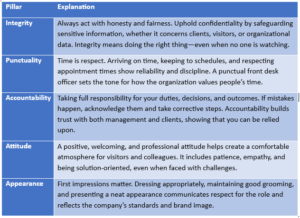
👉 In practice, these pillars work together. For example, punctuality without a professional attitude may still leave a negative impression, while appearance without integrity lacks true substance. A strong front desk professional balances all these pillars to inspire confidence and trust in the organization.
2.3 Customer Service Excellence
Customer Service Excellence goes beyond simply doing your job — it’s about creating memorable experiences. It means meeting and exceeding customer expectations in ways that leave a positive, lasting impression.
Think of it this way: every visitor, caller, or client interaction is a chance to show the heart of your organization.
💡 One simple but powerful framework to follow is the 3A Formula for Exceptional Service:
- Acknowledge – Greet people quickly and warmly. A smile, eye contact, or a polite nod goes a long way in making customers feel seen, respected, and valued.
- Assist – Don’t wait to be asked. Step in proactively, offer help, and provide clear, accurate answers. If you don’t have the solution, guide them to someone who does. Efficiency builds trust.
- Appreciate – Show genuine gratitude. Thank customers for their time, feedback, or even their complaints. Remember, complaints are not personal attacks — they are opportunities to improve and even turn frustrated customers into loyal advocates.
✨ “People will forget what you said, they’ll forget what you did, but they’ll never forget how you made them feel.”
— Maya Angelou
👉 In short, customer service excellence isn’t about perfection — it’s about connection. If you can make people feel respected, supported, and appreciated, they’ll remember your organization in a positive light.
Golden Rules of Customer Interaction
Delivering outstanding customer service isn’t just about handling requests—it’s about creating an experience people remember. At the front desk, every smile, word, and gesture becomes part of how visitors see the entire organization. That’s why mastering a few timeless “Golden Rules” of customer interaction is so important. These rules aren’t complicated—they’re simple, everyday habits that build trust, put people at ease, and leave them feeling valued. When practiced consistently, they transform ordinary exchanges into powerful moments that strengthen the reputation of both the staff and the brand.
1. Always Smile – Even Over the Phone
A genuine smile is one of the simplest yet most powerful tools in customer service. It communicates warmth, friendliness, and approachability before a single word is even spoken. Even when you’re on the phone, a smile changes the tone of your voice—making it sound more welcoming, calm, and reassuring. Customers may not see it, but they can definitely feel it. In fact, research shows that over 70% of customers say a friendly tone and attitude are more important than the words actually spoken—and smiling is the easiest way to achieve that.
Tip: Begin every interaction—face-to-face or over the phone—with a smile. It sets the stage for a pleasant conversation and shows customers they’re in capable, caring hands.
2. Use the Customer’s Name (When Known)
Personalization goes a long way in creating genuine connections. Calling a customer by name shows respect, attentiveness, and care—it transforms the interaction from transactional to personal. For example: “Good morning, Mrs. Amina. How may I assist you today?” feels far warmer than a generic greeting. And here’s the proof: studies show that 89% of customers are more likely to do business again with a company that personalizes their interactions.
Tip: If you’re unsure about pronunciation, ask politely. Far from being awkward, it shows the customer you value them enough to get it right.
🔸 3. Never Argue – Stay Calm and Respectful
Even when a customer is upset—or even wrong—the key is to remain calm, respectful, and professional. Arguing or raising your voice only fuels the situation, while a composed response helps to de-escalate it. Research backs this up: 68% of customers say they stay loyal to companies that handle complaints calmly and respectfully.
Golden Attitude: “I understand your concern. Let me see how best I can help.”
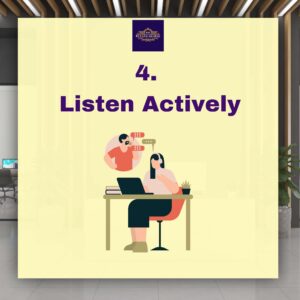
4. Listen Actively
Active listening is one of the most powerful tools in customer service. It’s not just about hearing words — it’s about understanding the customer’s feelings and concerns. By giving them your full attention, allowing them to speak without interruption, and responding thoughtfully, you show genuine care. In fact, 86% of customers say they are willing to pay more for better customer experiences, and active listening is at the heart of that experience.
Active Listening Phrases:
* “I see what you mean…”
* “Thank you for pointing that out…”
* “Just to confirm, you’re saying that…”
5. Follow Up and Follow Through
Trust is built on actions, not just words. When a customer raises an issue, never leave them in the dark. If it can’t be resolved immediately, let them know the next steps, give a clear timeline, and most importantly—follow through. Even a quick update like, “We’re still working on this, and I’ll keep you posted,” shows reliability. Research shows that 68% of customers leave a company because they feel the business doesn’t care about them — timely follow-ups prove the opposite.
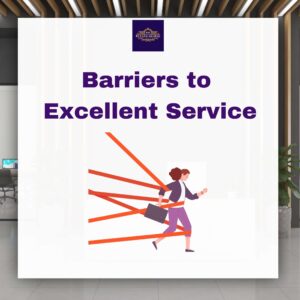
2.5 Barriers to Excellent Service
As much as you want to deliver excellent service, there are certain barriers that may stand in your way. By recognizing these challenges, you’ll be better prepared to overcome them and create positive experiences for every customer. Let’s look at the most common barriers:
⭐ Poor communication – If you don’t listen carefully or if you give unclear or incomplete information, customers may feel confused or frustrated. Always remember: communication is more than talking — it’s about listening, confirming details, and making sure the customer fully understands you.
⭐ Negative attitude – Customers can easily sense impatience, irritation, or indifference. Even one unfriendly interaction can undo all your good work. Approach every customer with a positive, helpful attitude — it makes them feel valued and respected.
⭐ Lack of product/service knowledge – Imagine a customer asking a question and you don’t know the answer. It immediately reduces their trust in you. That’s why you must continuously learn about your organization’s products or services, so you can respond with confidence and accuracy.
⭐ Disorganization or lack of preparation – If you appear unprepared or disorganized, customers may think you don’t know what you’re doing. Stay organized, keep your tools ready, and handle processes smoothly so that customers see efficiency and professionalism.
⭐ Stress or burnout – When you’re stressed or exhausted, it shows. You may lose patience, empathy, or the energy to give your best. That’s why it’s important to take care of yourself, manage your workload, and support your team. A healthy, motivated you means better service for your customers.
👉 Remember this: According to a PwC survey, 32% of customers will stop doing business with a brand after just one bad experience. You don’t want to be the reason a customer walks away, so learn to identify and overcome these barriers early.
One morning, Amaka had a heated argument with her husband at home about financial struggles in their marriage. She arrived at work visibly upset, distracted, and still replaying the quarrel in her mind.
At 9:00 AM, a parent walked into the school office to inquire about her child’s missing report card. Instead of greeting the parent warmly, Amaka sighed, rolled her eyes, and snapped:
> “You people are always coming here to disturb me. Didn’t you see other parents waiting?”
The parent, taken aback by her tone, tried to explain but Amaka cut her off, saying:
> “If you can’t wait, then come back another day. I don’t have time for this right now.”
Her unprofessional response, influenced by her unresolved anger from home, embarrassed the parent in front of others and created a negative impression of the school’s administration.
Result:
– The parent lodged a complaint to the principal.
– The school’s image suffered, as parents began questioning the professionalism of its staff.
– Amaka realized too late that she had allowed her personal marital issues to spill into her workplace behavior.
👉 This highlights the importance of emotional intelligence and personal boundaries in front desk roles—leaving personal struggles at home to maintain professionalism in customer-facing duties.

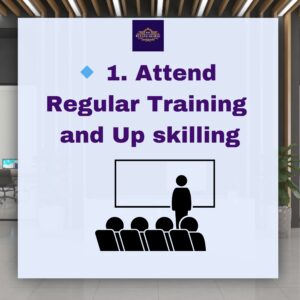
🔹 1. Attend Regular Training and Upskilling
To stay sharp and confident at the front desk, you must commit to continuous learning. The world of customer service is always evolving, and so are the tools, systems, and expectations you face every day. By regularly participating in training, you ensure that your skills remain relevant and that you can handle any situation with competence and ease.
As a front desk professional, consider taking part in:
⭐ Customer service workshops to refine your interaction skills
⭐ Communication skills training to speak clearly, confidently, and professionally
⭐ Conflict resolution and etiquette classes to handle tricky situations gracefully
⭐ Technology or software training that’s relevant to your organization
💡 Example: Learning to navigate modern appointment booking systems or CRM tools not only makes your job easier but also allows you to assist clients more efficiently, leaving a strong, professional impression every time.
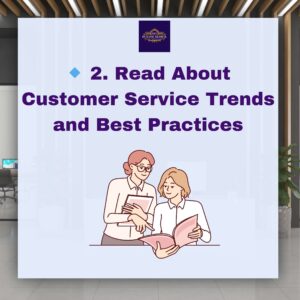
🔹 2. Read About Customer Service Trends and Best Practices
Great front desk professionals never stop learning. Remember, customer service is not static — it evolves with technology, culture, and customer expectations. If you want to remain outstanding, you need to stay ahead of the curve.
Here’s how you can do that:
✅ Read industry blogs, newsletters, and articles to keep up with the latest ideas
✅ Follow thought leaders and professionals on LinkedIn for fresh insights
✅ Explore books, podcasts, or short videos on hospitality and service excellence for daily inspiration
💡 Why this matters: When you stay informed, you’ll always be a step ahead. Imagine being the first in your workplace to introduce a new customer service approach or trend — it sets you apart as a proactive, knowledgeable professional that people look up to.
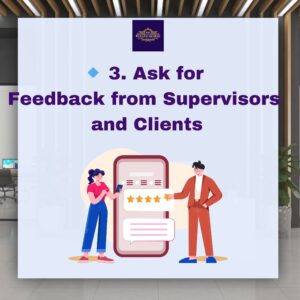
🔹 3. Ask for Feedback from Supervisors and Clients
Feedback is like a mirror — it shows you how others see your performance. The most successful front desk professionals don’t wait for annual appraisals; they actively seek input to grow.
Here’s how you can apply this:
✅ Regularly ask your supervisor for input on your performance — it shows initiative and commitment.
✅ Encourage clients to share their experience with you, whether formally (through surveys) or informally (through casual conversation).
✅ Be open-minded about criticism. Instead of feeling discouraged, use it as a powerful tool for improvement.
💡 Example you can use: “I’d really appreciate your feedback. Was there anything I could have done better during your visit?”
Remember: When you show a willingness to improve, you not only gain valuable insights but also build trust and respect with both your supervisors and clients.
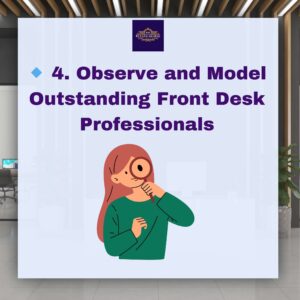
🔹 4. Observe and Model Outstanding Front Desk Professionals
One of the fastest ways to grow is by learning from those who are already excelling. Excellence often happens right around you — you just have to notice it.
Here’s how you can put this into action:
✅ Identify colleagues or mentors who stand out for their professionalism, warmth, and efficiency at the front desk.
✅ Watch closely how they carry themselves — their tone of voice, body language, conflict resolution style, and overall etiquette.
✅ Take note of what makes them effective, then adapt those techniques to fit your own personality and work environment.
💡 Example: If you notice a colleague calming an upset client with empathy and a calm voice, practice adopting a similar approach the next time you face a tense situation.
Remember: By modeling the best practices of outstanding professionals, you can accelerate your own growth and build confidence in real-life scenarios.
📝 Lessons to Take Home and Reflect On – Day 1
Today, you’ve learned that being at the front desk is more than just sitting behind a counter — it’s about influence, image, and impact. As you go home, take a moment to reflect on these key lessons:
✅ First impressions matter. Each greeting is a chance to shine. How do you present yourself each time a customer walks in?
✅ You are the face of the organization. The front desk is not just furniture; it’s the heartbeat of the company. Are you truly representing the values of your workplace in your actions and words?
✅ Professionalism is a choice you make daily. Respect, composure, and appearance speak volumes. Are you consistently carrying yourself in a way that builds trust?
✅ Every customer interaction is an opportunity. A smile, a kind word, or quick assistance can change someone’s day. Do you leave people feeling valued and appreciated after meeting you?
✅ Listening is powerful. Sometimes, giving someone your full attention is more impactful than giving an answer. Do you allow others to feel heard before you respond?
✅ Growth is intentional. No one improves by accident. What steps are you taking to learn, adapt, and get better each day?

✅ Principles of World-Class Customer Service
Delivering world-class customer service is not just about meeting basic expectations—it’s about creating memorable experiences that make people feel valued, respected, and cared for. Whether you’re welcoming guests at a hotel, registering patients in a hospital, answering inquiries in an office, or supporting clients in a government agency, the same principles of excellence apply worldwide.
Let’s break them down together:
- ✅ Responsiveness
Think about how you feel when someone ignores your message or keeps you waiting. Frustrating, right? Your customers feel the same. Responding promptly shows them that their needs matter to you.
- This means answering calls and emails quickly, avoiding unnecessary delays, and following up within the promised time.
🌍 Global best practice: Acknowledge every inquiry within 24 hours, even if you don’t have the full answer yet.
- ✅ Empathy
Service without empathy feels cold and robotic. When you step into your customer’s shoes, you show that you truly understand their feelings and frustrations.
- Listen without cutting them off, respond with compassion, and stay calm—even if the client is upset.
💡 Remember: People may forget your exact words, but they will never forget how you made them feel.
- ✅ Personalization
No one likes to feel like just another number. World-class service is about making each person feel recognized and special.
- Use their name, acknowledge repeat visits, and tailor your solutions to their unique needs.
🌍 Global tip: Many top organizations use CRM tools to track customer preferences and past interactions—helping them deliver a personal touch at scale.
- ✅ Professionalism
As a frontline representative, you are the face of your organization. The way you dress, speak, and handle pressure all shape how customers see your brand.
- Always remain calm, use respectful language, and focus on solutions rather than excuses.
👍 Professionalism builds trust, especially when situations get challenging.
- ✅ Consistency
Imagine if one day you received amazing service, but the next day it was poor. Would you still trust that organization? Probably not. That’s why consistency is key.
- Have clear service standards, train regularly, and document processes to ensure customers always get the same high-quality experience.
🎯 The goal is simple: Deliver dependable, predictable service—every single time.
📌 Quote to Remember:
“People may forget what you said, but they will never forget how you made them feel.” – Maya Angelou

✅ Handling Difficult Clients & Complaints
As front desk professionals—whether you’re working in hospitality, healthcare, corporate offices, education, or public service—you will inevitably face customer complaints. The key is to approach them with professionalism and empathy.
Remember: a complaint is not a threat. It’s an opportunity—to rebuild trust, recover from a service failure, and sometimes even turn an unhappy client into a loyal supporter.
🔸 Understanding Difficult Clients
Not all difficult clients are the same. They’re not your enemy; they’re simply people whose expectations, emotions, or situations are heightened. Recognizing the type of client you’re dealing with will help you respond effectively.
- 🕐 The Impatient Client
This client wants everything done right now. They dislike delays, hate queues, and may interrupt or speak over you. The challenge here is to stay calm and show them that their time is valued, even if you can’t speed things up.
- 💢 The Aggressive Client
This one may raise their voice, use harsh words, or even accuse you directly. They’re emotionally charged and can create tension in your workspace. Your role is to remain professional, avoid escalating the conflict, and guide the conversation back to solutions.
- 🤫 The Silent Complainer
This client won’t always tell you what’s wrong—they’ll show it through sighs, folded arms, or a cold tone. They may walk away without saying anything, only to leave a negative review later. Paying attention to body language and offering gentle, open-ended questions can make all the difference.
- 📋 The Overly Demanding Client
They want more than your service promises. Special requests, constant comparisons to competitors, and pushing for exceptions are common here. The key is to set boundaries politely but firmly while still making them feel heard and respected.

Steps to Handle Complaints Professionally — The HEARD Method
Mastering complaint resolution is essential to restoring trust and protecting your organization’s reputation. A great, research-based approach to this is the HEARD method—which stands for Hear, Empathize, Apologize, Resolve, and Diagnose.
While your own LEAFS approach (Listen, Empathize, Apologize, Fix, Follow-up) captures the essence, aligning with a widely recognized framework like HEARD ensures consistency with global best practices and clarity in training.
Here’s how HEARD works in action:
— Hear
First, invite the customer to speak. Listen actively—even more than you speak. By fully listening, you help them feel acknowledged and understood
— Empathize
Let them know you understand how they feel. Phrases like “I understand how upsetting this must be” go a long way in calming tense emotions and building rapport.
— Apologize
Offer a sincere apology—not as blame, but as validation of their experience. A calm, genuine “I’m sorry this happened” makes customers feel heard and sets the stage for resolution.
— Resolve
Take action to fix the issue. If you can resolve it on the spot, let them know the next steps. If not, ensure the situation is escalated or addressed appropriately
— Diagnose
After the resolution, reflect on what went wrong and why. This step ensures continuous improvement—preventing the issue from happening again
Why This Matters for You:
Using this method ensures that no customer feels ignored. It helps you move from reacting to complaints to resolving them with confidence and professionalism. It also empowers you to turn dissatisfied clients into satisfied, loyal advocates.
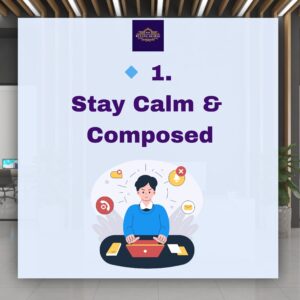
🧘 Stay Calm and Composed
When facing a difficult client, the very first step is to manage your own emotions. Remember: their frustration is about the situation, not about you personally.
✅ Do not take it personally – remind yourself that you are the professional in control.
✅ Maintain eye contact and a relaxed posture – this shows confidence and reassures the client that you are listening.
✅ Keep your voice steady and respectful – even if the client raises theirs, staying calm helps de-escalate the situation.
👉 Think of yourself as the “anchor in the storm.” The calmer you remain, the faster the client’s emotions will settle.
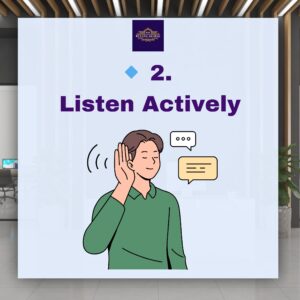
👂 Listen Actively
One of the most powerful tools you have when dealing with complaints is your ability to truly listen. Often, clients want to feel heard more than anything else.
✅ Allow the client to explain without interrupting – let them finish their thoughts before you respond. This shows respect and patience.
✅ Nod and use affirming words like “I see…” or “I understand.” – these small gestures reassure the client that you are engaged.
✅ Take notes if necessary to show attentiveness – writing things down demonstrates that you take their concerns seriously.
👉 Remember, listening is not just about hearing words; it’s about making the client feel valued and respected.
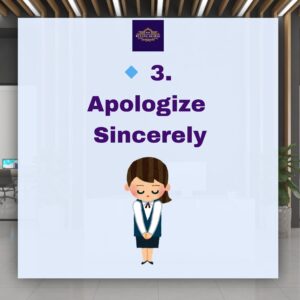
🙏 Apologize Sincerely
An honest apology can go a long way in calming a frustrated client. People often just want recognition of the inconvenience they’ve experienced.
✅ Acknowledge the inconvenience or frustration caused – let the client know you understand what they’re feeling.
✅ Even if it’s not your fault, show empathy – you represent the organization, so your empathy matters more than assigning blame.
✅ Use clear, simple words – for example: “I’m really sorry you had to wait so long.” This shows respect and compassion.
👉 Remember, a sincere apology doesn’t make you weak; it shows professionalism and emotional intelligence.

🔧 Find and Offer a Solution
Clients don’t just want apologies—they want action. Your role is to guide them from frustration to resolution.
✅ Clarify what the customer truly wants – ask gentle questions to fully understand their concern.
✅ Provide feasible options – be clear about what you can do rather than focusing on what you cannot.
✅ If you can’t resolve it immediately, explain the next steps – for example: “I’ll escalate this to my supervisor, and you’ll get a response within 24 hours.”
✅ Avoid saying “I can’t” – instead, reframe with: “Here’s what I can do to help…”
👉 Remember, every solution you offer is a chance to turn a negative experience into a positive memory.

📞 Follow Up for Satisfaction
Resolving the issue is not the finish line—true service excellence comes when you show the client you care even after.
✅ Check back with the client – whether by a quick call, an email, or in person, confirm they are satisfied with the outcome.
✅ Document the complaint and your actions – this helps your team learn, prevent future issues, and strengthen service delivery.
✅ Show appreciation – a simple “Thank you for your patience, we value you” leaves a lasting positive impression.
👉 Following up turns a one-time complaint into long-term trust.

TYPES OF CUSTOMERS
1 The Shouter Loud and Aggressive
🔥 Traits
🔊 Raises voice
🗯️ Uses harsh words
👀 Wants attention
⚠️ May intimidate other guests
🛠️ How to Handle
🧘 Stay calm and lower your voice
🚫 Do NOT shout back
🤝 Acknowledge feelings first
💬 What to Say
“I can see you’re upset and I want to help Let’s talk calmly so I can fix this for you”
📌 Key Rule
Calm ≠ Weak Calm is control
–
2 The Complainer Never Satisfied
🔁 Traits
🧐 Always finds fault
📝 Complains about small details
🔄 May be a repeat guest
🛠️ How to Handle
👂 Listen fully without interrupting
🧠 Separate valid issues from noise
🎯 Offer one clear solution
💬 What to Say
“Thank you for pointing this out Here’s what I can do immediately”
📌 Key Rule
Don’t argue details Solve one problem
–
3 The Silent but Angry Customer
😐 Traits
💬 Short answers
🧊 Cold tone
👁️ Avoids eye contact
🌋 Hidden but intense anger
🛠️ How to Handle
❓ Ask open ended questions
❤️ Show empathy gently
🕊️ Give space while offering help
💬 What to Say
“I sense something isn’t right Please let me know how I can assist”
📌 Key Rule
Silence doesn’t mean calm
–
4 The Blamer It’s Your Fault
👉 Traits
🧨 Accuses staff or company
🗣️ Uses you people
🎯 Wants someone to blame
🛠️ How to Handle
🧍 Don’t take it personally
📊 Focus on facts and solutions
🚫 Avoid defensive language
💬 What to Say
“I understand why this feels frustrating Let’s focus on fixing it”
📌 Key Rule
You are the solution not the target
–
5 The Entitled Customer
👑 Traits
🪪 I’m a regular
📣 Do you know who I am
🧾 Demands special treatment
🛠️ How to Handle
🤝 Be polite but firm
📜 Stick to policy with empathy
🔄 Offer alternatives not exceptions
💬 What to Say
“I understand your concern This is our policy but here’s what I can do”
📌 Key Rule
Respect without surrendering rules
–
6 The Impatient Customer
⏳ Traits
🚫 Hates waiting
⌚ Taps fingers checks watch
⚡ Easily irritated
🛠️ How to Handle
🙏 Acknowledge the delay
⏱️ Give realistic timelines
🔔 Update frequently
💬 What to Say
“Thank you for your patience This will take about 3 minutes”
📌 Key Rule
Uncertainty causes anger more than waiting
–
7 The Emotional Customer Personal Stress
💔 Traits
😢 Overreacts
😭 May cry or lash out
🧠 Issue is bigger than the service
🛠️ How to Handle
🫂 Be human first
👂 Listen without rushing
⏸️ Avoid policies initially
💬 What to Say
“I’m really sorry you’re going through this Let me see how I can help”
📌 Key Rule
Empathy first solution second
–
8 The Scammer or Manipulator
🕵️ Traits
⭐ Threatens bad reviews
💸 Demands unfair refunds
📢 Exaggerates issues
🛠️ How to Handle
📏 Stick strictly to policy
🗂️ Document everything
🚨 Involve supervisor early
💬 What to Say
“I’ll escalate this so it’s handled correctly”
📌 Key Rule
Professional not emotional
–
🌟 UNIVERSAL FRONT DESK RULES
🚫 Never argue
🚫 Never blame another department
🚫 Never say That’s not my job
🙏 Always thank them for their patience
📝 Always document incidents
–
🏆 GOLDEN FRONT DESK SCRIPT
“Thank you for bringing this to our attention I understand how frustrating this must be Let me check what I can do right away”
Obinna, a front desk officer at a four-star hotel in the UK, is working the evening shift. Around 9:00 p.m., a business traveler approaches the desk looking tired after a long day of meetings.
The guest says hurriedly:
“Please, I need an early wake-up service at 6:00 a.m. I have a very important flight tomorrow morning.”
Obinna nods quickly, thinking he understands, and enters a wake-up phone call request into the system. He doesn’t ask any follow-up questions such as:
– “Do you also need transport to the airport arranged?”
– “Would you prefer an alarm knock at your door or just a phone call?”
– “What time do you need the taxi ready?”
The next morning, at exactly 6:00 a.m., Obinna calls the guest’s room:
📞 “Good morning, this is your wake-up call.”
The guest replies groggily: “Okay, thank you.” Then, after freshening up, the guest comes down with luggage—only to discover there is no taxi waiting outside.
The guest rushes back to the desk, now visibly angry:
“I told you yesterday I had a flight! I expected a taxi ready for me. Because of this mistake, I’ve missed my airport check-in window. Do you know how much this flight cost me?!”
Obinna tries to explain: “Sir, you only asked for a wake-up service. That’s what I arranged.”
But the guest, feeling both misunderstood and neglected, storms off saying:
“This is the last time I’ll ever stay in this hotel. I’m posting this online right away.”
The aftermath is damaging:
— The hotel must refund the night’s stay as compensation.
— The guest leaves a scathing online review: “Terrible service! The staff don’t listen or clarify. Because of their incompetence, I missed my flight!”
— Other potential guests read the review, damaging the hotel’s reputation and bookings.
— Internally, Obinna receives a warning from management for not following guest communication protocols.
👉 The entire issue could have been avoided if Obinna had simply clarified with gentle questions like:
— “Would you like me to also arrange your taxi?”
— “Do you need transport waiting at 6:00 a.m. or later?”
Because he failed to clarify, the small misunderstanding snowballed into financial loss, reputational damage, and customer mistrust.

Key Takeaways
— Remember: clients may forgive a mistake, but rarely a poor response.
— Your response matters more than the issue itself—it can turn a complaint into loyalty or into a lost customer.
— Every complaint is a second chance—an opportunity to show professionalism and reinforce your brand’s commitment to excellent service.
🛠 Role Play Tip
Don’t just read these steps—practice them. Pair up and act out different complaint scenarios.
This will help you build emotional control and sharpen your response skills in real situations.

✅ Creating Positive First Impressions
“You never get a second chance to make a first impression.”
At the front desk, this couldn’t be more true—you are the very first connection clients, visitors, or stakeholders have with your organization. In those opening moments, the way you carry yourself can either inspire trust and comfort, or unintentionally create distance and doubt.
No matter where you work—whether it’s a hotel, a corporate office, a clinic, or a school—remember: you are the face of your organization in that moment.
🔹 Why First Impressions Matter
✅ First impressions are usually formed within the first 7–15 seconds of meeting someone.
✅ They are lasting—people often hold on to their first impression, even if things change later.
✅ A positive initial experience sets the tone for every future interaction with your organization.
👉 Think of yourself as a “trust builder” from the very first smile, word, and gesture.

🔸 Elements of a Good First Impression
To create a strong and lasting impression, every front desk officer should pay attention to the following:
- 👔 Clean and Neat Appearance
✅ Dress professionally and in line with company policy.
✅ Maintain personal hygiene—this includes grooming, tidy hair, and fresh breath.
✅ Avoid distracting accessories or heavy perfumes.
- 🧍 Confident Body Language
✅ Stand or sit upright with good posture.
✅ Avoid fidgeting or folding arms defensively.
✅ Smile genuinely—warmth is key.
- 🗣 Friendly Tone and Eye Contact
✅ Speak clearly, politely, and at a moderate pace.
✅ Use a welcoming tone of voice and ensure eye contact without staring.
✅ Tailor your greeting based on the situation, e.g., “Good morning, how may I assist you today?”
- ⏱ Prompt Acknowledgment and Greeting
✅ Don’t leave visitors or clients waiting without acknowledgment.
✅ Even if you’re busy, a quick “I’ll be with you shortly” shows professionalism.
✅ Make every guest feel seen and valued.
- 🧹 Organized and Tidy Workspace
✅ Keep your desk clutter-free and presentable at all times.
✅ Ensure signage, forms, and materials are properly arranged.
✅ A clean environment reflects your attention to detail and pride in your role.
💡 Pro Tip:
Front desk etiquette is not just about words—it’s about your energy.
Let people feel safe, respected, and welcomed the moment they arrive.
Chinedu had just secured a front desk job at a mid-sized corporate office in the UK. It was his first international role, and he wanted to prove himself. But on his second week, things went badly.
That morning, Chinedu rushed out of his apartment without ironing his shirt. His tie was hanging loosely, and in an attempt to cover up the smell of last night’s food, he had sprayed on way too much cologne.
At the office, instead of preparing his desk, he slouched in his chair, scrolling through WhatsApp messages. Papers from the previous day were scattered across his workspace, and two half-empty bottles of water sat beside the computer.
Around 9:15 a.m., a potential client walked in. She paused politely, expecting a warm greeting. Chinedu barely lifted his head. Without a smile, he muttered, “Yes? What do you want?”
The woman, surprised, introduced herself and explained she had a scheduled meeting. Chinedu, still half-focused on his phone, said in a flat tone, “You’ll have to wait. I’m busy.” He didn’t offer her a seat, nor did he make eye contact.
The client stood awkwardly for several minutes, shifting from foot to foot, clearly uncomfortable. By the time the manager arrived to receive her, the damage was already done—the woman felt unwelcome, disrespected, and was already questioning whether to work with the company.
Later that day, management received a complaint about the front desk experience. Chinedu’s lack of professionalism had left a lasting negative impression, not only on the client but also on his credibility as a newcomer abroad.
✅ Customer Satisfaction Metrics and Feedback
You can’t improve what you don’t measure. Every front desk operation should evaluate its service quality.
Common Metrics:
✅ Customer Satisfaction Score (CSAT): Measures how satisfied customers are with a single interaction (usually via a quick rating scale).
✅ Net Promoter Score (NPS): Gauges customer loyalty by asking if they’d recommend your organization to others.
✅ First Response Time: Tracks how quickly customer inquiries or requests are acknowledged.
✅ Customer Retention Rate: The percentage of customers who return or continue to use your services over time.
Feedback Collection Tools:
✅ Feedback forms at exit: Simple paper or digital forms guests fill before leaving.
✅ Online surveys: Email or link-based surveys that capture detailed experiences after the visit.
✅ Verbal feedback logs: Notes taken from face-to-face conversations about service experiences.
✅ Mystery shoppers: Independent visitors who assess service quality by posing as regular customers.
📊 Pro Tip: Always ask, “How did we do today?” before guests leave.

✅ Call & Visitor Management
The front desk is often described as the heartbeat of an organization—it is the first point of contact for both callers and visitors. The way calls are answered and guests are received not only reflects the efficiency of the organization but also shapes its reputation. Effective call and visitor management ensures smooth communication, professionalism, and a welcoming experience for everyone who interacts with the organization.
📞 Phone Etiquette
✅ Answer within 3 rings – Shows attentiveness and professionalism, ensuring callers don’t feel ignored.
✅ Greet with name and organization – Helps the caller know they’ve reached the right place and creates a personal connection.
✅ Speak clearly and professionally – Builds trust and prevents misunderstandings.
✅ Take accurate messages – Ensures smooth follow-up and avoids delays or errors.
👥 Visitor Management
✅ Confirm appointment or direct appropriately – Prevents confusion and saves the visitor’s time.
✅ Offer seat, water, or assistance – Shows hospitality and makes visitors feel valued.
✅ Ensure proper visitor registration/logging – Maintains security and accurate records of who enters and leaves.
🌟 Example Greeting
📞 “Thank you for calling Kuzang Global Academy. Dorcas speaking, how may I help you?”
✅ Filing, Record-Keeping & Scheduling
Behind every well-run office is a well-organized front desk. As the front desk officer, you are the keeper of order and flow—your filing, record-keeping, and scheduling practices determine how smoothly the organization operates day to day.
🗂 Filing Systems
✅ Alphabetical, Numerical, or Subject-Based – Helps you quickly find files and avoid wasting time searching for information.
✅ Digital vs Manual Filing – Digital systems (like cloud storage or internal servers) improve speed and accessibility, while manual filing is useful for physical records. Both should be kept neat and systematic.
✅ Confidentiality and Data Protection – Always protect sensitive information. Lock cabinets for physical files and use secure passwords for digital records.
📅 Scheduling Essentials
✅ Use digital calendars (e.g., Google Calendar, Microsoft Outlook) – Keeps schedules visible and accessible to both you and your team.
✅ Confirm appointments and send reminders – Reduces no-shows and ensures smooth daily planning.
✅ Avoid double-booking – Careful scheduling shows professionalism and respect for everyone’s time.
🌟 Best Practice
✅ Always keep a backup of key documents and maintain a tidy, well-labeled filing space. A clean system saves time and reduces stress during busy periods.“““

📂 Record Keeping for Front Desk Operations
Good record keeping is more than just paperwork — it’s a technical backbone of professional front desk operations. Whether in a hotel, hospital, school, or corporate office, accurate records ensure efficiency, accountability, and compliance.
✅ 1. Why Record Keeping Matters
📘 Accuracy – Prevents errors in billing, appointments, reservations, or guest details.
📘 Accountability – Provides a clear audit trail of decisions and actions.
📘 Compliance – Many industries (healthcare, finance, hospitality) require proper documentation by law.
📘 Efficiency – Speeds up service by giving quick access to information.
✅ 2. Types of Records Front Desk Staff Handle
📘 Communication Records – Call logs (incoming/outgoing), visitor messages, customer complaints/resolutions.
📘 Operational Records – Guest check-in/check-out forms, appointment schedules, service requests & work orders.
📘 Financial Records – Receipts/invoices, payment confirmations, refund/credit notes.
📘 Legal & Compliance Records – ID verification logs, incident reports, data protection/consent forms.
✅ 3. Technical Aspects of Record Keeping
📘 Consistency – Always use the same format (digital or paper) for accuracy.
📘 Data Entry Standards – Correct spelling, dates, and reference numbers.
📘 Confidentiality – Store sensitive information securely (passwords, locked cabinets, or encrypted systems).
📘 Accessibility – Authorized staff should be able to retrieve records quickly without confusion.
📘 Backup Systems – Use cloud storage or periodic physical backups to prevent data loss.
✅ 4. Tools for Record Keeping
📘 Property Management Systems (PMS) – Hotels (Opera PMS, Cloudbeds).
📘 Electronic Health Records (EHR) – Hospitals (Epic, Cerner).
📘 Office Management Software – Schools/offices (Trello, Zoho, Microsoft SharePoint).
📘 Manual Logs – Backup hardcopy registers for visitors, incidents, or emergencies.
✅ 5. Best Practices for Front Desk Staff
📘 Record information immediately — don’t rely on memory.
📘 Use clear handwriting or digital entry to avoid misinterpretation.
📘 Always verify customer details (names, contact, dates) before logging.
📘 Follow data protection laws (e.g., GDPR, HIPAA).
📘 Regularly audit records for completeness and accuracy.
📌 Key Takeaway:
Record keeping is not just admin work — it’s a technical skill that protects the organization, improves customer trust, and ensures smooth operations.

✅ Basic Office Equipment Usage
As the first point of contact, you’ll often be the go-to person when it comes to operating and maintaining everyday office tools. Knowing how to handle them not only improves efficiency but also ensures smooth workflow at the front desk.
🖨 Essential Equipment
✅ Printers & Scanners – Learn how to print, scan, and troubleshoot common issues (e.g., paper jams, low toner).
✅ Photocopiers – Practice making single- and double-sided copies, enlarging/reducing documents, and clearing basic errors.
✅ Multi-line Telephones – Handle incoming calls professionally, transfer calls correctly, and manage voicemail.
✅ Label Printers – Useful for tagging files, documents, or visitor badges to keep the office organized.
✅ Shredders – Safely dispose of confidential documents to protect sensitive information.
🛠 Quick Tip
✅ Always report faults, low supplies (like ink or paper), or recurring issues early to prevent workflow disruptions.
Musa Ibrahim, a Nigerian working as a front desk officer at a mid-sized corporate office in Toronto, Canada, had recently joined the team. Though hardworking and polite, Musa had little technical knowledge of handling essential office equipment — printers, scanners, photocopiers, shredders, and multi-line telephones. Unfortunately, he never asked for proper training, believing he could “figure things out as he went.”
🖨 The Printer & Scanner Incident
One Monday morning, a senior manager urgently needed to print and scan confidential legal documents for a client meeting. Musa tried to operate the high-capacity office printer but became frustrated when it showed a “Low Toner Warning.”
Instead of following procedure (logging the error and requesting replacement toner from IT), Musa forcefully shook the toner cartridge and reinserted it. Toner powder spilled inside the machine, causing a major jam. By the time IT arrived, the printer was completely unusable. The legal team missed their deadline, costing the company credibility with the client
📑 The Photocopier Mistake
Later that week, Musa was asked to photocopy 200 double-sided financial reports. Unfamiliar with the settings, he accidentally printed the reports on single-sided pages, wasting reams of expensive company paper.
When asked to redo them, he attempted to “fix” a paper jam himself by pulling sheets incorrectly, damaging the machine’s rollers. The photocopier was out of service for days, delaying internal reporting.
☎ The Multi-line Telephone Error
During a busy morning, Musa was handling the office’s multi-line telephone system. A client called in with an urgent request, but instead of transferring the call to the right department, Musa mistakenly placed the client on hold indefinitely. The caller eventually hung up in frustration.
The company later learned that this was a key business partner who felt neglected and unprofessional treatment at the front desk.
🗂 The Label Printer & Shredder Negligence
Musa also struggled with smaller tools. He misused the label printer, printing dozens of unnecessary labels, wasting ribbons, and sticking them incorrectly on client files. Even worse, he once overloaded the paper shredder with thick documents, causing the motor to burn out. The repair cost hundreds of dollars.
🚨 The Consequences
Within three months, the company had spent significant money on equipment repairs, paper wastage, and lost valuable client trust. Management reviewed security camera footage and logs, realizing that Musa’s incompetence at handling office equipment was the root cause.
Despite warnings and minor retraining attempts, the final straw came when Musa damaged another replacement printer by inserting the wrong type of paper.
The company terminated his contract, citing gross negligence and failure to follow operational training.
📌 Lesson:
To person when it comes to operating and maintaining everyday office tools, knowing how to handle them not only improves efficiency but also ensures smooth workflow at the front desk.
Front desk officers must:
* 📘 Learn to properly use printers, scanners, and photocopiers.
* 📘 Handle multi-line telephones with care and professionalism.
* 📘 Follow protocols for shredders and label printers.
* 📘 Always seek clarification and training rather than “guessing.”
Musa’s story is a reminder that technical competence at the front desk is just as important as customer service skills.

✅ Front Office Software & Technology Trends
In today’s workplace, technology is reshaping how front desks operate. As a front desk professional, being tech-savvy gives you an edge and keeps you in demand.
💻 Common Software You’ll Use
✅ CRM Tools (e.g., Zoho, Salesforce) – Help track and manage customer relationships, appointments, and follow-ups.
✅ Hotel Front Desk Systems (e.g., Opera PMS) – Used in hospitality for reservations, check-ins/outs, and billing.
✅ Office Management Tools (e.g., Trello, Slack) – Improve communication, task management, and collaboration with your team.
✅ Visitor Management Software – Records guest information, prints badges, and enhances office security.
🚀 Emerging Technology Trends
✅ Virtual Front Desks – Remote staff or kiosks assisting guests without needing a person on-site.
✅ AI Chat Assistants – Automated bots that answer common questions and assist visitors 24/7.
✅ Contactless Check-ins – Touch-free systems using QR codes or mobile apps for smooth and safe visitor entry.
🌐 Pro Tip
✅ Stay updated by challenging yourself to learn at least one new tool or software each month. This habit makes you future-ready and highly marketable.
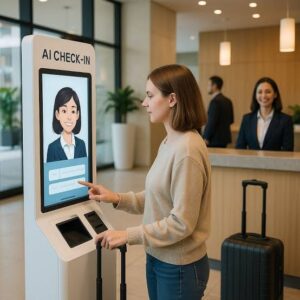
AI-Powered Check-In Kiosks at Zedwell Hotels (Criterion Hospitality)
In London, Zedwell hotels began using AI-powered kiosks supplied by software provider Mews to streamline their check-in process. This move reduced check-in time drastically—from the usual 3–10 minutes down to just 2.5 minutes—and allowed the company to shrink its reservations team by two-thirds. The efficiencies stemmed from integrating AI chatbots, WhatsApp, and virtual check-in capabilities, improving both cost and guest experience.
Highly Personalized Virtual Reception Kiosks (Aavgo)
Aavgo’s systems combine kiosk hardware with human assistance. Guests interact with a large screen—complete with ID scanner, key dispenser, payment terminal, and mobile key integration—and get support via chat, SMS, or video call. This hybrid model offers automation and human touch in one seamless experience

Module 5: Safety, Security & Crisis Handling
As front desk professionals, you are not just the first point of contact—you are also the first line of defense when it comes to safety and stability. Beyond welcoming guests and offering assistance, your role extends to ensuring security, confidentiality, and calmness during emergencies.
On Day 3, we will dive into practical strategies and protocols to help you:
✅ Stay composed under pressure and guide others with confidence.
✅ Safeguard sensitive information and protect the privacy of guests and the organization.
✅ Respond effectively to unexpected situations such as health crises, security threats, or system failures.
✅ Support overall safety and ensure that both clients and employees feel secure.
👉 By the end of this module, you will be equipped to not only handle emergencies with professionalism but also to inspire trust and confidence in everyone who walks through your doors.
🔐 5.1 Front Desk Security Protocols
As front desk professionals, you are the first line of defense for your organization. Security awareness is not optional—it is a responsibility that ensures the safety of everyone in the workplace.
Here are your key responsibilities:
✅ Verify Visitor Identity – Always confirm the identity of every visitor before granting access. A friendly smile is important, but never compromise on protocol.
✅ Log Guest Details & Issue Passes – Record each guest’s details accurately and provide them with a visitor pass. This ensures transparency and traceability at all times.
✅ Notify Departments of Arrivals – Once a guest arrives, promptly inform the relevant department. This prevents confusion and ensures smooth coordination.
✅ Monitor for Suspicious Behavior – Stay alert. If you notice unusual behavior, trust your instincts and report it immediately rather than ignoring it.
✅ Coordinate with Internal Security Teams – Work closely with the organization’s security team whenever necessary. Your cooperation helps maintain a secure and controlled environment.
👉 Remember: Professionalism and alertness at the front desk can prevent serious security breaches.

Terkula Iorfa, a young professional from Benue State, Nigeria, works as a front desk officer in a busy corporate office in Dubai. His day usually starts with greeting guests warmly while strictly adhering to the company’s security protocols.
One morning, a visitor arrived claiming to have a meeting with the finance manager. The man seemed polite but appeared hesitant when asked for identification.
✅ Step 1: Verify Visitor Identity
Instead of allowing him through immediately, Terkula smiled politely and requested an official ID. The visitor presented a business card but no government-issued identification.
✅ Step 2: Log Guest Details & Issue Passes
Following protocol, Terkula explained calmly that company policy required a valid ID for entry. After some hesitation, the visitor eventually produced a passport. Terkula logged the guest’s details accurately and issued a visitor pass.
✅ Step 3: Notify Departments of Arrivals
Terkula called the finance department to confirm the appointment. Surprisingly, the manager responded that no such meeting had been scheduled.
✅ Step 4: Monitor for Suspicious Behavior
Trusting his instincts, Terkula observed that the visitor was becoming increasingly uneasy and tried to pressure him to allow entry without confirmation.
✅ Step 5: Coordinate with Internal Security Teams
Without raising alarm, Terkula signaled the security team discreetly. They approached and escorted the visitor away for further checks. It was later discovered that the individual had previously attempted unauthorized entry into other offices in the building.
👉 Lesson: Thanks to Terkula’s alertness, professionalism, and adherence to protocols, a potential security breach was prevented. His actions reinforced why front desk officers are indeed the first line of defense in any organization.

🖥 Visitor Management Systems (VMS)
A Visitor Management System (VMS) is a digital tool used to record, monitor, and manage all visitor activities within an organization. Instead of relying on traditional pen-and-paper logbooks, VMS provides a secure, accurate, and efficient way to handle visitor data.
🔑 Key Functions of VMS:
✅ Visitor Registration – Guests can check in through tablets, kiosks, or with your assistance at the front desk. Their personal details, purpose of visit, and host department are recorded instantly.
✅ ID Verification & Badges – Many systems allow ID scanning, photo capture, and automatic generation of visitor badges, which helps to verify identity and prevent unauthorized access.
✅ Notifications & Alerts – Once a visitor checks in, the system notifies the concerned staff or department. This ensures that guests are not left waiting unnecessarily.
✅ Access Control Integration – Some VMS solutions connect with building access systems (e.g., keycards, biometric doors), ensuring that only approved visitors can enter restricted areas.
✅ Real-Time Monitoring – Security teams can track who is currently in the building, reducing risks during emergencies such as fire drills or evacuations.
✅ Data Storage & Confidentiality – Unlike manual logbooks that can be misplaced or tampered with, VMS securely stores visitor data for future reference, audits, or compliance requirements.
✅ Benefits of Using VMS
➡ Enhanced Security – Ensures only authorized visitors gain access by verifying identities through ID scans, photos, or pre-registration.
➡ Professional Image – Gives visitors a modern first impression of the organization, showing that the company values efficiency and safety.
➡ Real-Time Tracking – Allows staff to know exactly who is in the building at any given moment.
➡ Data Accuracy – Eliminates errors from manual logbooks, ensuring visitor records are neat, searchable, and stored safely.
➡ Emergency Preparedness – During fire drills, lockdowns, or emergencies, VMS provides an instant list of all visitors for evacuation or safety checks.
🛡 Roles of VMS in Front Desk Operations
➡ Streamlined Check-In Process – Visitors can self-register using kiosks or tablets, reducing wait times at the reception.
➡ Visitor Identification – Generates visitor badges with photos, making it easy for staff to identify authorized guests.
➡ Notification Alerts – Automatically notifies employees when their guests arrive, avoiding unnecessary delays.
➡ Confidential Record Keeping – Safeguards sensitive data by storing visitor logs securely, with access only for authorized personnel.
➡ Integration with Security Systems – Can be linked with access control, CCTV, or ID systems to create a stronger security network.
🎥 CCTV Surveillance
Closed-Circuit Television (CCTV) systems are one of the most important security tools at the front desk. As the “eyes” of the organization, they help monitor real-time activities, deter potential threats, and provide evidence in case of incidents. Front desk professionals must understand their role in effectively utilizing CCTV systems.
🔎 Importance of CCTV Surveillance
➤ Deterrence of Crime: Visible cameras discourage unauthorized or suspicious behavior.
➤ Evidence Collection: CCTV recordings serve as proof during investigations, disputes, or legal cases.
➤ Monitoring High-Traffic Areas: Ensures the safety of entrances, exits, lobbies, and restricted zones.
➤ Emergency Support: During crises (e.g., theft, fire, intruder alert), security teams can use footage to respond quickly.
📌 Responsibilities of Front Desk Staff in CCTV Management
➤ Basic Familiarity: Know where cameras are positioned and which areas they cover.
➤ Real-Time Monitoring: Keep an eye on live feeds for unusual activity, especially in entry/exit points.
➤ Incident Reporting: Immediately alert security if suspicious activity is noticed.
➤ Confidentiality: Never share CCTV footage or information without authorization.
➤ System Awareness: Understand how to escalate technical issues (e.g., when cameras are offline).
⚠️ Best Practices for CCTV Usage
➤ Do Not Solely Rely on CCTV: Combine camera monitoring with physical observation.
➤ Respect Privacy: Avoid misuse of surveillance, such as watching irrelevant areas.
➤ Consistent Logging: Record any incident observed through CCTV in the front desk security logbook.
➤ Stay Alert: Treat the system as a safety tool, not background noise.
🛡 Benefits to the Organization
➤ Enhances overall security and creates a safer environment for employees and visitors.
➤ Protects company assets and property from theft or damage.
➤ Supports compliance with insurance and legal requirements.
➤ Builds trust among staff and visitors, showing that safety is a priority.
🔑 Access Control Systems (Card, Biometric, etc.)
Access Control Systems are essential for protecting your workplace from unauthorized entry and ensuring that only the right people gain access to restricted areas. As a front desk professional, you play a key role in supporting and monitoring these systems.
✅ Why Access Control Matters
Access control isn’t just about locking doors — it’s about creating a safe, organized, and accountable environment. According to a global security report, 67% of organizations experienced unauthorized access incidents due to weak entry controls. That’s why strong systems and alert front desk oversight are vital.
📌 Common Types of Access Control Systems
➡ Card-Based Access
Employees or visitors use ID or access cards to enter restricted areas.
Front desk staff may issue temporary access cards for guests.
Cards can be deactivated immediately if lost or stolen.
➡ Biometric Access (Fingerprint, Facial Recognition, Iris Scan)
Provides a high level of accuracy because each person’s biometrics are unique.
Reduces the risk of “tailgating” (when someone follows an authorized person in).
Often used in high-security zones such as data centers or executive offices.
➡ PIN or Password-Based Systems
Requires users to enter a unique code to gain access.
Easy to set up but less secure if passwords are shared.
Front desk officers should discourage code-sharing to maintain integrity.
➡ Multi-Factor Authentication (MFA)
Combines two or more methods (e.g., card + fingerprint, or PIN + facial recognition).
Offers the highest level of protection.
Becoming increasingly common in sensitive industries like finance and healthcare.
👩💼 Role of the Front Desk Officer
➡ Verification – Confirm visitor credentials before issuing temporary access cards.
➡ Monitoring – Keep an eye on access logs for unusual activity.
➡ Reporting – Immediately notify security of suspicious attempts or system alerts.
➡ Education – Remind employees and visitors not to share access cards or codes.
➡ Emergency Handling – Assist with lockouts or access resets in coordination with security teams.
⚠ Best Practices for You as a Front Desk Professional
➡ Always issue visitor passes with clear expiration times.
➡ Double-check IDs before handing over access credentials.
➡ Never leave access cards or biometric devices unattended.
➡ Stay updated on company security policies and access control protocols.
🚨 Panic Buttons / Emergency Alarms
Panic buttons and emergency alarms are critical tools that empower front desk professionals to respond quickly and discreetly in times of crisis. They serve as silent or loud alerts that immediately notify internal security teams, law enforcement, or emergency responders about a dangerous situation.
✅ Purpose
➤ Provide an immediate way to call for help during emergencies (e.g., break-ins, violent confrontations, medical crises).
➤ Act as a deterrent to potential threats when visible.
➤ Allow front desk officers to discreetly raise an alert without escalating the situation.
✅ Types of Panic/Emergency Systems
➤ Silent Panic Buttons – send discreet alerts to security personnel without drawing attention.
➤ Audible Alarms – loud sirens to alert everyone on the premises and scare off intruders.
➤ Mobile Panic Systems – apps or handheld devices that trigger alarms, useful in large facilities.
➤ Integrated Systems – connected to CCTV and access control for faster coordinated response.
✅ Best Practices for Front Desk Officers
➤ Know the Location – Always be aware of where panic buttons are installed.
➤ Use Only in Genuine Emergencies – Avoid misuse that may cause false alarms.
➤ Stay Calm After Activation – Do not panic; continue managing the situation while help is on the way.
➤ Train for Scenarios – Practice drills to know how to use alarms effectively during crises.
✅ Benefits of Panic Buttons / Emergency Alarms
➤ Rapid response – Immediate notification shortens reaction time.
➤ Enhanced safety – Protects staff, guests, and property.
➤ Peace of mind – Front desk officers feel more secure knowing backup is one press away.
➤ Professional image – Shows clients that safety is a priority.
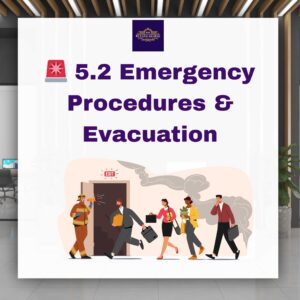
🚨 5.2 Emergency Procedures & Evacuation
In any emergency, you at the front desk are the first point of action. Guests, clients, and staff will look to you for direction, so your calmness and clarity are critical.
🔥 Types of Emergencies You May Face:
➡ Fire Outbreak – Smoke, alarms, or visible flames require immediate activation of fire protocols.
➡ Medical Emergencies – Guests, staff, or visitors collapsing, fainting, or suffering accidents.
➡ Natural Disasters – Floods, earthquakes, or storms that disrupt safety and normal operations.
➡ Security Threats – Bomb scares, aggressive intruders, or suspicious packages.
🧭 Your Role in Emergencies:
1. Activate Alarm Systems & Notify Emergency Services
➡ Do not waste time. Hit the emergency alarm or panic button.
➡ Call security, police, fire service, or ambulance as appropriate.
2. Follow Evacuation Protocols
➡ Know all exit routes and assembly points.
➡ Never use elevators during fire or power-related emergencies.
➡ Lead by example—remain calm and direct others.
3. Guide Guests and Staff Calmly
➡ Give clear, firm, but polite instructions.
➡ Offer extra support to vulnerable individuals (elderly, children, or disabled guests).
➡ Prevent panic by using a steady tone and confident body language.
4. Account for Individuals
➡ Ensure all visitors and staff who signed in are checked off at the assembly point.
➡ Report anyone missing immediately to emergency responders.
5. Document the Incident
➡ Record what happened, actions taken, and people involved.
➡ This helps management improve future responses.
📌 Key Preparedness Tips:
➡ Participate actively in all safety drills.
➡ Familiarize yourself with evacuation maps and fire extinguishers.
➡ Keep emergency contacts visible and updated at the front desk.
➡ Practice handling pressure so you remain composed.
Remember: Your role is not just administrative—it’s about being a leader in safety.

🔏 5.3 Information Confidentiality & Data Protection
At the front desk, you are often the gatekeeper of sensitive information—ranging from visitor records and employee details to company documents and confidential conversations. How you handle this information reflects not only on your professionalism but also on the integrity and trustworthiness of the entire organization. Protecting data is not optional; it is a core responsibility that ensures privacy, builds client confidence, and safeguards the organization against legal or reputational risks.

🔒 Confidential Communication
➡️ Never discuss internal matters in public spaces – Confidential details should be handled discreetly and only within secure areas.
✅ Do’s:
➡️ Hold sensitive conversations in closed offices or secure meeting rooms.
➡️ Lower your voice when discussing necessary details at the desk.
➡️ Use professional email or secured communication channels instead of casual chats.
➡️ Redirect clients politely if they ask for information you are not authorized to share.
❌ Don’ts:
➡️ Don’t share staff issues, internal disputes, or management discussions in public areas.
➡️ Don’t discuss guest/client information in lobbies, elevators, or open spaces.
➡️ Don’t leave sensitive documents or notes on the front desk unattended.
➡️ Don’t gossip about internal affairs with visitors, colleagues, or on social media
💻 Digital Security – Lock Screens
➡️ Always lock your computer screen when leaving the desk, even for a short moment. This prevents unauthorized access and protects sensitive data.
✅ Do’s:
➤ Use strong passwords or authorized access cards to log in.
➤ Lock your screen (Ctrl + L / Windows + L / Command + Control + Q) whenever stepping away.
➤ Enable auto-lock after a few minutes of inactivity.
➤ Report any suspicious login attempts or unauthorized access immediately.
❌ Don’ts:
➤ Don’t leave your computer unattended while logged in.
➤ Don’t share your login credentials with colleagues or guests.
➤ Don’t write down passwords on sticky notes or visible papers at the desk.
➤ Don’t disable screen-lock or auto-lock settings.
➤ Do not leave documents exposed
Confidentiality breaches don’t always happen through hacking or digital theft—sometimes the simplest mistakes, like leaving papers unattended, can cause serious damage. Guests, contractors, or even colleagues without proper clearance may glance at sensitive information if documents are left in open view. This could include client details, financial records, medical information, or internal reports.
To safeguard against this risk:
➤ Always place documents in secure storage (drawers, locked cabinets, or designated filing areas) immediately after use.
➤ Use privacy folders or sealed envelopes for forms, contracts, or identification documents.
➤ When working on sensitive papers, keep them face down when stepping away, even briefly.
➤ Avoid stacking papers carelessly on the desk—neatly store or file them as soon as possible.
➤ Shred unneeded documents instead of tossing them in open bins.
➤ Ensure visitors and unauthorized staff cannot access areas where files are handled.
By being mindful of how documents are handled, you reduce the risk of accidental exposure and uphold your organization’s trust and reputation.
➤ Shred or properly dispose of confidential information
Disposing of documents carelessly is one of the fastest ways for sensitive information to leak outside the organization. Items like visitor logs, printed emails, draft contracts, medical records, or identification copies can all be misused if found in open trash bins.
To prevent this:
➤ Always use a shredder for outdated or unnecessary documents containing personal, financial, or company-sensitive details.
➤ For bulk disposal, place papers in secure “to-be-shredded” bins rather than leaving them around.
➤ Avoid tossing documents directly into regular trash cans where cleaners, visitors, or outsiders might access them.
➤ For digital files, ensure proper deletion—use secure erase tools rather than simply moving files to the recycle bin.
➤ Follow company policy on record retention and destruction to remain compliant with data protection regulations.
Proper disposal isn’t just neatness—it’s a legal and ethical responsibility that protects clients, employees, and the organization.

➤ Adhere to Data Protection Regulations
Every organization must comply with relevant data protection laws to ensure information is collected, stored, and shared responsibly. As a front desk professional, awareness and adherence to these regulations is crucial because even small lapses can lead to legal consequences, financial penalties, or reputational damage.
Examples include:
➤ GDPR (General Data Protection Regulation – Europe): Protects the personal data and privacy of individuals within the European Union and applies to any organization handling such data, regardless of location.
➤ NDPR (Nigeria Data Protection Regulation): Nigeria’s framework for safeguarding personal information, ensuring data subjects’ rights are respected and organizations remain accountable.
➤ HIPAA (Health Insurance Portability and Accountability Act – USA): Governs the confidentiality and security of healthcare-related information, ensuring patient records are strictly protected.
By following these regulations, front desk professionals uphold both ethical standards and legal obligations in handling sensitive data.
➤ A breach of data can cost not only money but reputation
Data breaches are more than technical failures—they directly impact trust. A single incident of mishandled information can lead to costly fines, lawsuits, and the permanent loss of client or guest confidence. For a front desk professional, every piece of information handled—whether spoken, written, or digital—must be considered privileged. Always treat names, addresses, phone numbers, identification documents, health details, and company records with the highest level of confidentiality. Protecting this information demonstrates professionalism, safeguards the organization’s image, and preserves valuable relationships.
📣 5.4 Crisis Communication & Handling Pressure Situations
How you communicate in a crisis can either build trust or break it completely. Front desk officers are often the first point of contact when something goes wrong, so your words, tone, and body language matter.
✅ Do’s in Crisis Communication
➤ Remain calm, professional, and in control—your composure reassures others.
➤ Use short, clear sentences. Avoid jargon or complicated terms that may confuse people under stress.
➤ Show empathy while staying objective—acknowledge emotions without letting them cloud facts.
➤ Prioritize safety before explanations—people must feel secure before they can process information.
⚡ Handling Pressure Effectively
➤ Breathe deeply and ground yourself before responding—this prevents rushed or panicked reactions.
➤ Avoid emotional reactions. Mirror confidence, not chaos—others will reflect the stability you project.
➤ Seek help when needed—don’t try to manage everything alone; teamwork is crucial in emergencies.
💡 Key Insight: Emotional intelligence (EQ) is a core skill in managing high-pressure scenarios. Studies show that 90% of top performers in customer-facing roles score high in EQ, making it a vital asset for crisis management.


🌍 6.1 Overview of International Protocols & Regulatory Bodies
Understanding and following global standards not only boosts your professional credibility but also aligns you with best practices recognized worldwide. These standards ensure that services are delivered with consistency, safety, and integrity, regardless of location.
🔑 Key Organizations & Their Roles
⭐ IATA – International Air Transport Association
→ Sets global safety, operational, and service standards in the travel and tourism industry.
→ Provides training and certification recognized worldwide, enhancing career mobility.
→ Ensures that airlines, airports, and service providers deliver safe, reliable, and efficient experiences for travelers.
⭐ ISO – International Organization for Standardization
→ Develops and publishes international quality, safety, and management standards (e.g., ISO 9001 for Quality Management, ISO 31000 for Risk Management).
→ Helps organizations maintain consistency, reliability, and trustworthiness in their operations.
→ Enhances competitiveness by ensuring products and services meet global benchmarks.
⭐ OSHA – Occupational Safety and Health Administration
→ Provides frameworks for workplace health and safety, particularly influential in the U.S. but widely referenced globally.
→ Focuses on accident prevention, employee well-being, and safe working environments.
→ Encourages organizations to adopt proactive safety cultures, reducing risks and liabilities.
✅ Why This Matters for You:
Familiarity with these organizations and protocols makes you more adaptable in a global workforce. Employers value professionals who understand international expectations and can apply them to deliver world-class service and safety.

🏅 6.2 Global Best Practices in Front Desk Operations
To stand out internationally, front desk professionals must adapt to practices that are recognized, valued, and respected around the world. One of the most important of these practices is communication across languages and cultures.
⭐ Multilingual Proficiency or Polite Working Knowledge of Key Phrases
Why it matters:
The front desk is often the first and last point of contact for guests, clients, or patients. Being able to greet and assist them in their own language creates an immediate sense of comfort, trust, and respect. Even if you are not fluent, knowing polite key phrases demonstrates cultural sensitivity and effort, which clients deeply appreciate.
Examples of key phrases to learn:
➡️ Greetings: “Hello, Good morning, Good evening”
➡️ Courtesy: “Please, Thank you, Excuse me, You’re welcome”
➡️ Assistance: “How can I help you? Do you need directions? One moment, please.”
➡️ Safety/Emergency: “Stay calm, Help is coming, This way, please.”
Languages to prioritize internationally:
Depending on your industry and location, some of the most useful global languages include:
➡️ English – The universal business and travel language.
➡️ French – Widely spoken across Africa, Europe, and parts of Canada.
➡️ Spanish – Dominant across Latin America, Spain, and parts of the U.S.
➡️ Arabic – Important across the Middle East and North Africa.
➡️ Mandarin Chinese – Essential in global trade and growing tourism.
➡️ Local/National Languages – Shows respect for culture and improves guest relations.
Professional advantage:
Employers worldwide actively seek front desk officers who can handle international guests with ease. A multilingual officer is not just a receptionist—they become a bridge of communication that enhances brand reputation.
Tips for practical improvement:
➡️ Use language apps (e.g., Duolingo, Babbel) daily to build basics.
➡️ Carry a cheat sheet of phrases for common situations.
➡️ Practice active listening to pick up guest needs, even when words aren’t clear.
➡️ Watch body language and tone, as they can communicate friendliness when words fail.
➡️ Partner with colleagues who speak different languages to role-play scenarios.
✅ Bottom Line: Even a small effort in speaking a guest’s language makes a big difference. It transforms the interaction from transactional to personal, setting a high global standard in front desk operations.
Adekunle Okeke, from Nigeria, recently started working as a front desk officer at a busy hotel in Zurich, Switzerland. On his first day, a group of French-speaking guests arrived for check-in. Adekunle greeted them warmly in English, assuming they would understand, and handed over the registration forms.
➡ What went wrong:
The guests struggled to understand the instructions and asked simple questions in French like, “Où est notre chambre?” (“Where is our room?”). Adekunle, unfamiliar with French phrases and unable to communicate basic directions politely, became flustered. He waved at the elevator without explaining clearly and accidentally gave them the wrong room key.
➡ Consequences:
The guests were frustrated and complained to the manager.
Adekunle’s lack of multilingual proficiency made the interaction uncomfortable, lowering the hotel’s service reputation.
Staff morale was affected because other team members had to spend extra time fixing the issue.
➡ Lesson Learned:
Even if you’re not fluent, knowing polite key phrases in the guest’s language—or using translation tools—can prevent misunderstandings and demonstrate cultural sensitivity. A front desk officer is not just a receptionist—they are the face of the hotel. Multilingual skills are crucial in making international guests feel welcome, respected, and confident in your service.
✅ Takeaway for Participants:
Always learn basic greetings, courtesy words, and key phrases in languages common to your location.
Use language apps, cheat sheets, or colleague practice sessions to improve daily.
Remember: failing to communicate effectively can lead to guest dissatisfaction, complaints, and reputational damage—an avoidable scenario with proper preparation.
⭐ Cultural Sensitivity in Service Delivery
In today’s interconnected world, front desk professionals often interact with people from diverse cultural, religious, and social backgrounds. Cultural sensitivity goes beyond simply being polite—it is about respecting differences, avoiding stereotypes, and delivering services in a way that makes every guest or client feel valued and respected.
✔ Respect for customs and traditions: Understand that certain greetings, gestures, or even eye contact may have different meanings across cultures. For example, a firm handshake may be appreciated in one culture but considered inappropriate in another.
✔ Inclusive communication: Use neutral and respectful language. Avoid slang, idioms, or humor that may not translate well or could unintentionally offend.
✔ Awareness of religious practices: Be mindful of dietary restrictions, prayer times, dress codes, or holidays that may affect a guest’s requests or needs. For instance, offering halal or vegetarian options where necessary shows awareness and care.
✔ Flexibility and adaptability: Adjusting your approach based on cultural cues demonstrates professionalism. For example, some cultures value small talk before business, while others prefer direct communication.
✔ Non-verbal sensitivity: Tone of voice, gestures, and personal space vary globally. Recognizing these differences helps prevent misunderstandings and ensures comfort.
✔ Continuous learning: Cultures evolve, and no one can know everything. Stay curious, ask respectful questions when appropriate, and keep updating your cultural awareness skills.
By practicing cultural sensitivity, you not only avoid conflicts but also build trust, loyalty, and a reputation for excellence that meets international standards.
⭐ Use of Technology in Front Desk Operations
Technology has become a cornerstone of modern front desk management. From improving efficiency to creating memorable guest experiences, the right tools help professionals stay competitive and align with global standards.
✔ Customer Relationship Management (CRM) Systems:
CRM platforms store and track guest information—such as preferences, booking history, and feedback. This allows front desk officers to deliver personalized service, like remembering a returning guest’s favorite room type or addressing them by name. A well-used CRM builds stronger client loyalty and enhances the guest experience.
✔ Property Management Systems (PMS):
PMS software is essential in hotels and organizations that manage multiple reservations. It automates room bookings, check-in/check-out processes, billing, and housekeeping coordination. With a PMS, front desk staff spend less time on paperwork and more time focusing on guest satisfaction.
✔ AI Chatbots and Virtual Assistants:
Artificial Intelligence tools provide 24/7 customer support, answering frequently asked questions, handling simple booking requests, and providing real-time information. This reduces wait times for guests while allowing human staff to focus on more complex issues that require empathy and judgment.
✔ Self-Service Kiosks and Mobile Apps:
In global best practices, many establishments use kiosks or apps that allow guests to check in, make payments, or request services independently. This increases convenience, reduces queues, and appeals to tech-savvy travelers.
✔ Data Analytics and Reporting Tools:
Modern systems track guest behaviors and generate reports that help managers forecast demand, identify trends, and make data-driven decisions. For instance, analytics can show which services are most popular, helping the front desk anticipate guest needs.
✔ Cybersecurity and Data Privacy:
With great technology comes great responsibility. Front desk staff must understand data protection laws (e.g., GDPR, NDPR) and handle guest information securely. Protecting sensitive data builds trust and demonstrates professionalism on a global scale.
By embracing these technologies, front desk operations become faster, smarter, and more guest-focused, ensuring organizations meet international service standards while staying ahead of competitors.
⭐ Zero Tolerance for Discrimination or Harassment
A world-class front desk professional must uphold the highest ethical standards by ensuring inclusivity, fairness, and respect for all. Discrimination and harassment have no place in professional environments, and embracing a zero-tolerance culture builds trust with guests, colleagues, and the organization.
✅ Equal Treatment of All Guests & Staff
Every individual, regardless of nationality, race, gender, religion, age, disability, or social class, should be treated with dignity and respect. For example, a guest with limited mobility deserves the same courtesy and attention as any other visitor.
✅ Awareness of Local and International Anti-Discrimination Laws
Front desk staff should familiarize themselves with laws such as the U.N. Human Rights Principles, Equal Employment Opportunity (EEO) regulations, and workplace harassment policies. This knowledge ensures that service delivery is not only courteous but also legally compliant.
✅ Proactive Prevention of Harassment
Harassment can take many forms—verbal, physical, or psychological. Professionals must maintain boundaries, avoid inappropriate comments, and immediately report any incident. A respectful workplace encourages collaboration and professionalism.
✅ Cultural & Social Inclusion
Guests and colleagues often come from diverse backgrounds. Creating an environment where everyone feels welcome, regardless of language, appearance, or beliefs, enhances customer loyalty and employee satisfaction.
✅ Crisis Management in Discriminatory Incidents
If a guest or colleague reports discrimination, the front desk professional should:
Remain calm and professional.
Listen empathetically without judgment.
Escalate the issue immediately to the appropriate authority or HR.
Document the incident factually.
✅ Long-Term Benefits
By enforcing zero tolerance for discrimination and harassment, organizations build:
Stronger reputations globally.
Higher employee retention.
Greater guest loyalty and trust.
Biola, a young and enthusiastic Nigerian front desk officer, had recently started working at a prestigious conference center in Geneva, Switzerland. On a busy morning, she was assigned to check in a group of international delegates arriving for a global business summit. Among them was a Japanese executive, who greeted her with a polite bow—a customary sign of respect in Japanese culture.
Biola, eager to be friendly and outgoing, extended a firm handshake and smiled widely. She said, “Good morning! Welcome! You’ll love our facilities here,” while chuckling lightly. A few other delegates from different countries smiled politely but looked slightly puzzled.
➡ What went wrong:
➤ The Japanese delegate appeared uncomfortable but refrained from correcting Biola, not wanting to seem rude.
➤ Biola continued to make casual jokes about “being too formal,” not realizing that humor could easily be misinterpreted across cultures.
➤ As she explained the hotel’s amenities, she used idiomatic phrases like, “You’ll hit the ground running!” and “Our lounge is top-notch, the bee’s knees!” which confused several delegates whose first language wasn’t English.
➤ Biola also handed out printed schedules without explaining clearly, assuming everyone understood the layout and flow of the day.
➡ Consequences:
➤ Some delegates whispered among themselves, expressing mild frustration at the lack of clarity.
➤ The Japanese executive and a few others felt awkward and slightly disrespected, noting the cultural misalignment in their feedback.
➤ Biola’s overconfidence and lack of awareness of cultural differences caused tension and delays during check-in.
➤ The feedback forms later highlighted the need for staff to improve cross-cultural communication skills.
➡ Lesson Learned:
This scenario highlights how even well-intentioned actions can go wrong when cultural sensitivity is overlooked. Simple gestures like observing the guest’s greeting style, avoiding slang, and using clear, neutral language can prevent discomfort.
✅ Takeaway for Participants:
➤ Learn the basics of common cultural greetings and gestures in your region.
➤ Avoid humor, slang, or idioms that may not translate well.
➤ Observe body language and cues from guests to adjust your communication style.
➤ When in doubt, politely ask or mirror the guest’s greeting.
➤ A culturally aware front desk officer can turn a potentially awkward interaction into a positive experience, enhancing both guest satisfaction and the organization’s reputation.
⭐ Customer-Centric Mindset: Exceed Expectations, Personalize Experiences
A world-class front desk professional goes beyond simply meeting guest needs—they anticipate them, adapt quickly, and create memorable experiences. The goal is to make every visitor feel valued and respected, turning ordinary interactions into lasting positive impressions.
🔹 Exceeding Expectations
Guests often come with basic needs: directions, check-ins, or inquiries. A customer-centric mindset means doing more than the minimum. For example:
➡️ Offering a refreshing drink while a guest waits.
➡️ Proactively suggesting local attractions or services they might enjoy.
➡️ Remembering frequent visitors’ names and preferences.
🔹 Personalizing Experiences
People value being treated as unique individuals. Personalization can be as simple as:
➡️ Greeting guests by their names instead of “sir/ma.”
➡️ Adjusting communication style to suit different personalities (formal, friendly, reserved).
➡️ Recognizing special occasions (birthdays, anniversaries) and offering a small courtesy note or gesture.
🔹 Consistency
High-quality service must be consistent across all interactions. Whether it’s the first or the tenth time a guest visits, they should receive the same level of professionalism, warmth, and efficiency. This builds trust and loyalty.
🔹 Empathy
Understanding emotions is at the heart of customer service. A front desk professional should:
➡️ Listen actively without interrupting.
➡️ Show genuine concern when a guest is stressed, upset, or confused.
➡️ Respond with patience and compassion, even under pressure.
🔹 Innovation in Service Delivery
Global best practices involve using modern tools and creative approaches to enhance guest experience. For example:
➡️ Offering digital check-in systems to reduce waiting times.
➡️ Providing multi-language support for international visitors.
➡️ Using feedback kiosks or follow-up emails to continuously improve service.
🔹 Long-Term Benefits
A strong customer-centric mindset ensures:
➡️ Guests become repeat customers and brand ambassadors.
➡️ Positive reviews and referrals increase the organization’s reputation.
➡️ The workplace culture becomes more collaborative and guest-focused.

🚀 6.3 Career Growth & Certification Pathways
✨ Career Progression
Front desk roles are not just entry-level; they provide a solid foundation to grow into leadership and specialized positions. With the right skills and continuous development, professionals can transition into:
Guest Relations Executive – Focuses on building long-term relationships with clients, handling VIP guests, and ensuring exceptional experiences.
Office Administrator – Oversees daily office operations, coordinates departments, and ensures smooth administrative functions.
Front Office Manager – Supervises the front desk team, manages schedules, and ensures service delivery meets global standards.
Client Services Lead – Works closely with corporate or institutional clients to resolve issues, manage accounts, and exceed service expectations.
Hotel/Resort Manager – Oversees overall hospitality operations, including front office, housekeeping, food and beverage, and customer satisfaction.
Executive Assistant – Supports top executives with scheduling, communication, document handling, and professional representation.
Concierge Supervisor – Specializes in providing personalized services, from travel arrangements to special requests, ensuring high guest satisfaction.
🌐 Certification Pathways
Professional certifications validate skills, enhance credibility, and open doors to international opportunities. Some globally recognized and industry-relevant certifications include:
IATA Customer Service Certificate – Equips professionals with knowledge of international aviation and travel service standards.
Certified Front Desk Representative (CFDR) – Recognized credential proving competence in front desk operations, professionalism, and hospitality skills.
ISO Training Certifications – Covers quality, safety, and service management standards (e.g., ISO 9001 Quality Management, ISO 31000 Risk Management).
Kuzang Global Academy Proficiency Certificates – Provides hands-on training tailored to global business and hospitality standards.
Hospitality and Business Administration Diplomas – Broader qualifications that prepare candidates for managerial roles in hotels, resorts, offices, and multinational organizations.
💡 Key Insight: Continuous learning = Continuous elevation.
The more you invest in professional growth, the more opportunities you unlock for global employability, higher salaries, and leadership roles.
🌍 6.4 Workplace Diversity & Inclusion
A professional front desk environment thrives on equity, respect, and inclusiveness. In today’s global workplace, the front desk is often the first point of contact, making it crucial to embody values that welcome and honor everyone.
Embrace:
⭐ Differences in language, ethnicity, religion, and physical abilities
Respecting cultural, religious, and physical diversity shows guests and colleagues that every individual is valued. For example, knowing how to greet guests in different languages or understanding cultural holidays fosters stronger relationships.
⭐ Non-discriminatory practices in greeting and serving guests
Every guest deserves equal treatment regardless of their background, beliefs, or appearance. Professionalism requires setting aside personal biases and ensuring fairness in communication, tone, and service delivery.
⭐ Accessibility-friendly setups (e.g., ramps, signs for the hearing impaired)
Creating an inclusive physical space ensures comfort for all. This can include wheelchair access, braille signs, visual alerts, and priority seating. Small gestures of accessibility signal a strong commitment to inclusivity.
💡 Why it matters:
Diversity and inclusion are not just moral obligations but also business strengths. Inclusive workplaces lead to:
Higher employee morale and teamwork.
Improved guest satisfaction and loyalty.
Stronger alignment with global service standards.
Inclusion = Better Productivity + Enhanced Service + Positive Brand Reputation.