
📌 Day 1: Introduction to Restaurant Management & Industry Trends
Session 1: Understanding the Restaurant Industry
🔹 Overview of the Global and Local Restaurant Industry
The restaurant industry is a vital component of the hospitality and food service sector, contributing significantly to national economies worldwide. It encompasses a broad range of establishments, from fine dining and quick- service restaurants (QSRs) to cafés, catering services, and food trucks.
🌍 Global Restaurant Industry at a Glance
The restaurant industry has evolved into a multi-trillion-dollar industry, heavily influenced by:
- Consumer trends and dietary preferences (e.g., health-conscious eating, plant-based diets)
- Technological advancements (e.g., online ordering, AI-driven customer service)
- Economic factors and disposable income affecting dining habits
- Post-pandemic transformations, including increased demand for food delivery services
- Sustainability and eco-friendly practices, such as zero-waste restaurants and farm-to-table concepts
According to Statistic, the global restaurant industry revenue surpassed $3 trillion in 2023, with continuous growth driven by urbanization, globalization, and digital transformation.
🇳🇬 Local Restaurant Industry (Example: Nigeria & Africa)
In countries like Nigeria, Ghana, Kenya, and South Africa, the food service industry plays a significant role in employment and economic development. Key insights include:
- The rise of fast-food chains and casual dining due to urbanization and changing lifestyles
- Growth of local delicacy-based restaurants, offering traditional African cuisines
- The increasing demand for mobile and online food delivery services
- Strict food safety regulations enforced by agencies like NAFDAC (Nigeria), KEBS (Kenya), and SANS (South Africa)
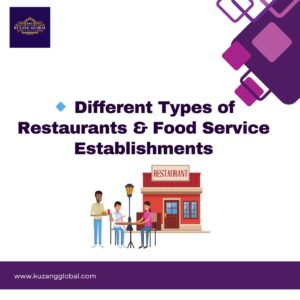
🔹 Different Types of Restaurants & Food Service Establishments
The restaurant industry is diverse, catering to various customer preferences, budgets, and service styles. Below are key categories:
1⃣ Fine Dining Restaurants
- High-end restaurants offering premium quality food, exceptional service, and elegant ambiance
- Examples: Michelin-star restaurants, exclusive steakhouses, gourmet French and Italian restaurants
- Target Market: Affluent clientele, business executives, and special occasion diners
2⃣ Casual Dining Restaurants
- More relaxed than fine dining but offers table service and a comfortable atmosphere
- Examples: Family restaurants, ethnic cuisine (Chinese, Indian, Lebanese, African), grill houses
- Target Market: Middle-income families, young professionals, tourists 3⃣ Quick-Service Restaurants (QSRs) / Fast Food
- Focus on speed, affordability, and convenience
- Examples: McDonald’s, KFC, Domino’s Pizza, Mr. Bigg’s (Nigeria), Chicken Republic (Africa)
- Target Market: Busy professionals, students, lower and middle-income earners
4⃣ Cafés & Coffee Shops
- Specialize in coffee, tea, and light snacks with a cozy setting
· Examples: Starbucks, Café Neo (Nigeria), Vida e Caffè (South Africa)
- Target Market: Remote workers, students, casual meet-ups 5⃣ Buffets & Self-Service Restaurants
- Customers serve themselves from a variety of dishes at a fixed price
· Common in hotels, cruise ships, and large dining halls
- Target Market: Families, large groups, tourists 6⃣ Food Trucks & Street Food Vendors
- Mobile food service businesses offering affordable, fast meals
- Examples: Shawarma stands, burger trucks, suya spots, jollof rice stalls
- Target Market: Commuters, festival-goers, students 7⃣ Catering & Banquet Services
- Provide customized meals for events, corporate gatherings, and weddings
- Examples: Luxury event caterers, outdoor grill services, private chefs
- Target Market: Event organizers, companies, individuals hosting celebrations
8⃣ Ghost Kitchens / Virtual Restaurants
- Online-only restaurants with no physical dining space, delivering via apps like Uber Eats, Jumia Food
- Growing due to the rise of digital food ordering and cost efficiency
- Examples: Cloud kitchens, virtual pizzerias, online-only burger joints
🔹 Career Opportunities in Restaurant Management
The restaurant industry offers diverse career paths beyond being a chef. These include:
1⃣ Restaurant Manager
- Oversees daily operations, staff management, and financial performance
- Ensures customer satisfaction and regulatory compliance
- Average Salary: $40,000 – $100,000 annually (depending on location and experience)
2⃣ Food & Beverage Manager
- Responsible for menu planning, food purchasing, and supplier relations
- Works closely with chefs and kitchen staff to maintain quality standards
3⃣ Executive Chef / Head Chef
- In charge of kitchen operations, menu creation, and food quality control
- Manages kitchen staff and ensures compliance with food safety regulations
4⃣ Restaurant Owner / Entrepreneur
- Owns and operates a restaurant business, responsible for marketing, staffing, and profitability
- Requires knowledge in finance, customer service, and strategic planning 5⃣ Catering Manager
- Plans and manages catering services for events, corporate gatherings, and private parties
- Works with clients to customize menus based on preferences and budgets
6⃣ Hospitality Consultant
- Advises restaurant owners on business strategy, food safety compliance, and market positioning
- Typically hired by startups or struggling businesses seeking profit improvement strategies
7⃣ Food Safety & Hygiene Officer
- Ensures compliance with health codes, HACCP regulations, and hygiene best practices
· Works in restaurants, hotels, food production companies, and government agencies
8⃣ Restaurant Marketing Manager
- Develops and implements marketing strategies to increase brand visibility and customer retention
· Specializes in social media marketing, influencer partnerships, and loyalty programs
INTERACTIVE QUESTION
- “What makes a restaurant business successful in today’s competitive market?”
📌 Summary of Key Takeaways
✔ The restaurant industry is a dynamic, fast-growing sector with global and local opportunities
✔ Various restaurant types exist, catering to different customer needs and market segments
✔ Career opportunities go beyond being a chef—restaurant managers, food safety officers, and hospitality consultants are in high demand
✔ Technology, sustainability, and food safety are key drivers of the modern restaurant industry
Session 2: Principles of Restaurant Management
Introduction
Restaurant management is a multifaceted discipline that involves overseeing operations, ensuring excellent customer service, maintaining food quality, managing finances, and leading a team. Effective restaurant managers must master various skills to ensure seamless operations and business success.
This session will cover:
✅ Core responsibilities of a restaurant manager
✅ Key success factors in restaurant operations
✅ Case study: Best practices from top-performing restaurants
1. Core Responsibilities of a Restaurant Manager
A restaurant manager is responsible for the day-to-day operations and long- term success of the restaurant. Their responsibilities can be categorized into the following areas:
1.1 Operational Management
· Overseeing front-of-house (FOH) and back-of-house (BOH) operations
- Ensuring food quality, hygiene, and presentation meet industry standards
- Managing reservations, seating arrangements, and service flow
1.2 Staff Supervision & Leadership
- Hiring, training, and supervising staff members
- Scheduling and assigning tasks efficiently
- Motivating employees and fostering a positive work environment
- Enforcing workplace safety and compliance with labor laws
1.3 Customer Experience & Service Quality
- Ensuring excellent customer service and guest satisfaction
- Handling customer complaints professionally and efficiently
- Implementing feedback systems to improve service quality
- Creating a warm, welcoming ambiance to enhance customer loyalty
1.4 Financial & Cost Control
- Managing budgets, sales targets, and financial performance
- Controlling food costs, inventory, and waste management
- Setting profitable menu pricing strategies
- Analyzing daily financial reports and optimizing profitability
1.5 Marketing & Business Growth
- Promoting the restaurant through digital marketing, social media, and promotions
- Managing customer loyalty programs and partnerships
- Engaging in community outreach and public relations
- Implementing strategies for increasing foot traffic and online visibility
2. Key Success Factors in Restaurant Operations
For a restaurant to be successful, managers must focus on critical areas that drive efficiency, profitability, and customer satisfaction.
2.1 Quality Food & Beverage Service
- Maintaining consistent food quality and presentation
- Ensuring menus align with customer preferences and industry trends
- Offering seasonal specials and unique signature dishes
2.2 Efficient Operational Workflow
- Streamlining kitchen operations for minimal wait times
- Ensuring proper stock management to avoid shortages or excess waste
- Coordinating FOH and BOH teams for seamless service delivery
2.3 Staff Training & Retention
- Regular training on customer service, food handling, and compliance
- Recognizing and rewarding employee performance to reduce turnover
- Creating a collaborative team culture for improved productivity
2.4 Customer-Centric Approach
- Implementing personalized service techniques
- Encouraging feedback through surveys and social media
- Adopting technology such as POS systems and online reservations to enhance convenience
2.5 Compliance with Health & Safety Standards
· Adhering to food safety regulations (HACCP, ISO 22000, local food codes)
- Conducting regular health inspections and staff hygiene training
- Ensuring emergency preparedness and adherence to workplace safety protocols
3. Case Study: Best Practices from Top-Performing Restaurants
Case Study: The Success Story of Nkoyo Restaurant, Abuja
Nkoyo Restaurant, located in the heart of Abuja, Nigeria, has built a reputation as one of the finest dining experiences in the country. It is known for its authentic Nigerian cuisine, exceptional service, and a blend of traditional and contemporary ambiance.
Key Lessons from Nkoyo’s Success:
✅ Locally Sourced Ingredients:
Nkoyo prioritizes farm-to-table dining, sourcing fresh, organic ingredients from
local farmers to ensure high-quality meals while supporting the local economy.
✅ Exceptional Customer Experience:
The restaurant provides personalized service, training staff to be courteous, attentive, and knowledgeable about the menu, creating a warm and welcoming atmosphere.
✅ Creative Menu Engineering:
Nkoyo continuously updates its menu to feature a mix of classic Nigerian dishes and modern interpretations, appealing to both traditional and international guests. Dishes like Nsala soup, suya-spiced steak, and jollof rice with grilled seafood are crafted to delight the taste buds.
✅ Sustainable Business Model:
The restaurant follows environmentally responsible practices, including minimal food waste, biodegradable packaging, and energy-efficient kitchen operations. Their commitment to sustainability has earned them a loyal customer base.
✅ Strong Brand Identity & Marketing:
Nkoyo leverages social media, influencer marketing, and customer loyalty programs to engage with their audience and attract new customers. Their Instagram-worthy presentations and high-quality food photography have helped them grow their brand presence online.
Discussion Question:
“What strategies can small and medium-sized restaurants adopt from Nkoyo to improve customer satisfaction and business sustainability?”
Conclusion
Mastering the principles of restaurant management requires strong leadership, financial acumen, and a commitment to customer satisfaction and operational excellence. Implementing industry best practices can help managers build sustainable and profitable restaurant businesses.
Key Takeaways:
✅ A restaurant manager’s role includes operations, staff supervision, customer service, finance, and marketing.
✅ Key success factors include food quality, operational efficiency, staff training, and customer focus.
✅ Learning from successful case studies helps managers adopt best practices
and stay competitive.
📌 Break time (10 Minutes)
Day 1 Break Discussion Question: Industry Trends & Innovations
👉 “What are some of the most innovative restaurant trends you have observed or experienced? How can restaurant managers adapt to these trends to stay competitive?”
SESSION 3: INDUSTRY TRENDS & INNOVATIONS
Introduction
The restaurant industry is constantly evolving due to changing consumer preferences, technological advancements, and global challenges. Staying updated on emerging trends and innovations is essential for restaurant owners and managers to maintain competitiveness, improve efficiency, and enhance
customer experiences. This session explores key industry trends, sustainability practices, and technological advancements that shape the modern restaurant business.
1. Emerging Trends in Food Service and Dining Experiences
Consumer expectations and dining behaviors continue to evolve, influenced by health trends, technology, and cultural shifts. Understanding these trends helps restaurants adapt and cater to customer preferences effectively. Below are some of the most impactful trends in the food service industry:
a. Experiential Dining
- Customers seek unique, immersive dining experiences beyond just food. This includes:
- Themed restaurants (e.g., space-themed, jungle-inspired, medieval dining).
- Interactive dining (e.g., chefs preparing food tableside, DIY meal options).
- Multi-sensory experiences integrating visuals, music, and
b. Health and Wellness-Oriented Menus
- The demand for health-conscious dining options is increasing, with customers preferring:
- Organic and farm-to-table
- Gluten-free, vegan, and plant-based menu
- Low-carb, high-protein, and superfood-rich
c. Ghost Kitchens & Virtual Restaurants
- The rise of delivery-only restaurants without physical dining
- Operate via food delivery platforms (e.g., Uber Eats, DoorDash, Glovo).
- Lower overhead costs and the ability to cater to multiple cuisines from one kitchen.
d. Personalized Dining Experiences
- Restaurants are using customer data to customize dining experiences:
- AI-driven menu recommendations based on past
- Customizable meal plans and allergy-friendly
- Loyalty programs that offer rewards based on dining
2. Sustainability and Eco-Friendly Practices in Restaurants
Sustainability in the restaurant industry is no longer optional but a necessity due to increased consumer awareness and environmental concerns. Implementing eco-friendly practices can reduce costs, attract conscious diners, and ensure compliance with environmental regulations.
a. Waste Reduction Strategies
- Implementing zero-waste policies:
- Composting food
- Donating surplus food to
- Using AI to optimize food inventory and reduce over-
b. Sustainable Sourcing
- Restaurants are shifting towards locally sourced and ethical ingredients:
- Supporting local farmers and reducing carbon
- Using responsibly sourced seafood (MSC-certified fish, farmed shrimp, etc.).
- Partnering with ethical coffee and fair-trade
c. Energy and Water Conservation
- Energy-efficient kitchens use:
- Smart refrigeration systems to optimize power
- Motion-sensor lighting in storage areas and dining
- Low-energy dishwashers and water-saving kitchen
d. Eco-Friendly Packaging
- Sustainable packaging options include:
- Biodegradable and compostable containers instead of
- Edible cutlery and plates (e.g., wheat-based straws, rice husk bowls).
- Offering discounts to customers who bring reusable
3. Technology in Restaurant Management
Technology has become a game-changer in restaurant operations, helping streamline management, improve customer experiences, and boost revenue. Key technological innovations include:
a. POS Systems (Point of Sale Systems)
- Advanced POS systems now offer:
- Cloud-based ordering for better accuracy and
- Inventory tracking to prevent stock outs and food
- Customer data analytics for personalized marketing
b. AI-Driven Analytics & Predictive Insights
- Artificial Intelligence (AI) is transforming restaurant operations by:
- Forecasting demand to optimize food
- Analyzing customer trends to suggest popular
- Automating staffing schedules based on predicted busy
c. Contactless Ordering & Digital Payments
- The shift to cashless transactions and self-service options:
- QR code menus to minimize physical
- Mobile app ordering for convenience and faster
- Cryptocurrency and digital wallets for secure
d. Robotics & Automation in Restaurants
- The integration of robotics in food service:
- Automated kitchen assistants for food
- Robot waiters in high-tech
- AI-driven chatbots for customer support and
Conclusion
The restaurant industry is undergoing rapid transformation due to changing consumer behaviors, sustainability demands, and technological advancements. By staying updated on industry trends and innovations, restaurant managers can enhance customer experiences, optimize efficiency, and achieve long- term business success.
Discussion Questions
- Which of the emerging trends discussed would you consider implementing in a restaurant, and why?
End of Class tonight
That’s all for tonight’s session! 🎉
Now, it’s time for the Q&A Session. Please:
✅ Answer all discussion questions in the group.
✅ Ask your own questions if you need clarification on today’s lesson.
Looking forward to your participation! See you in the next session tomorrow, same time. 🚀😊
📌 Day 2:
Restaurant Operations & Customer Service Excellence Session 1: Restaurant Operations Management
📍 Introduction to Restaurant Operations Management
Restaurant operations management is the backbone of a successful food service establishment. It involves the planning, organization, execution, and supervision of all restaurant activities to ensure seamless operations, customer satisfaction, and profitability.
In this session, we will explore Standard Operating Procedures (SOPs), Front-of- House (FOH) vs. Back-of-House (BOH) management, and handling peak-hour rush effectively.
📌 Standard Operating Procedures (SOPs) in a Restaurant
What Are SOPs?
Standard Operating Procedures (SOPs) are detailed written instructions that outline how tasks should be carried out in a restaurant to maintain efficiency, consistency, quality, and compliance with health and safety regulations.
Why Are SOPs Important?
✅ Ensure consistency in food quality, service, and hygiene.
✅ Improve efficiency and workflow, reducing errors and miscommunication.
✅ Ensure compliance with health and safety standards (e.g., HACCP, FDA, WHO).
✅ Help in staff training by setting clear expectations.
✅ Reduce operational risks and improve customer satisfaction.
Common SOPs in a Restaurant:
1. Food Preparation & Handling SOPs
- Storage and labeling of
- Cooking and portion
- Safe handling of perishable
2. Service SOPs (FOH Operations)
- How to greet and seat
- Order-taking procedures (digital/manual).
- Guest complaint
3. Cleaning & Sanitation SOPs
- Cleaning schedules (hourly, daily, weekly).
- Proper dishwashing and
- Personal hygiene standards for
4. Inventory & Supply Chain SOPs
- Receiving and inspecting
- FIFO (First-In, First-Out) method for stock
- Waste management and
5. Cash Handling & Payment SOPs
- Secure handling of cash and credit
- Digital payment
- Preventing fraud and
- Key Takeaway: SOPs serve as the restaurant’s rulebook for operations, ensuring that all tasks are performed efficiently and consistently.
📌 Front-of-House (FOH) vs. Back-of-House (BOH) Management
Understanding FOH & BOH
A restaurant is divided into Front-of-House (FOH) and Back-of-House (BOH). Managing both efficiently ensures a seamless guest experience and smooth operations.
🔹 Front-of-House (FOH) – The Customer Interaction Zone
FOH includes all areas where customers interact with restaurant staff. This area plays a crucial role in customer experience and satisfaction.
Key Responsibilities of FOH Staff:
✅ Greeting and seating customers.
✅ Taking and delivering orders accurately.
✅ Managing reservations and walk-ins.
✅ Handling customer complaints and special requests.
✅ Maintaining cleanliness and ambiance.
Common FOH Roles:
- Restaurant Manager – Oversees all
- Host/Hostess – Welcomes guests and manages
- Waiters/Servers – Take orders and serve
- Bartender – Prepares and serves
- Cashier – Handles customer
FOH Best Practices:
✔ Use customer-friendly language and maintain a positive attitude.
✔ Listen actively and address customer complaints immediately.
✔ Keep tables clean and dining spaces organized.
✔ Train staff in upselling techniques to boost sales.
🔹 Back-of-House (BOH) – The Kitchen & Operations Hub
BOH includes everything that happens behind the scenes, from food preparation to kitchen management. A well-managed BOH ensures quality food, timely service, and safety compliance.
Key Responsibilities of BOH Staff:
✅ Preparing food according to SOPs.
✅ Maintaining cleanliness and hygiene in the kitchen.
✅ Managing food inventory and minimizing waste.
✅ Ensuring compliance with health and safety regulations.
Common BOH Roles:
- Executive Chef – Oversees kitchen
- Sous Chef – Assists in food preparation and
- Line Cook – Prepares specific dishes based on
- Dishwasher – Ensures all kitchen tools and dishes are
- Kitchen Supervisor – Ensures compliance with food safety
BOH Best Practices:
✔ Follow proper food safety standards (HACCP, ISO 22000).
✔ Maintain efficient kitchen workflow to reduce delays.
✔ Train staff on fire safety and first aid procedures.
✔ Implement inventory tracking systems to minimize food wastage.
• Key Takeaway:
FOH and BOH must work in harmony for a restaurant to function efficiently. Communication, training, and teamwork between these departments are critical to customer satisfaction and operational success.
📌 Managing Peak-Hour Rush & Ensuring Smooth Operations
What Is Peak-Hour Rush?
Peak hours refer to high-traffic periods in a restaurant, typically during:
✔ Breakfast (7 AM – 10 AM)
✔ Lunch (12 PM – 2 PM)
✔ Dinner (6 PM – 9 PM)
✔ Weekends and public holidays
Handling peak hours efficiently prevents customer dissatisfaction, service delays, and kitchen stress.
Best Strategies for Managing Peak-Hour Rush:
✅ Effective Staff Scheduling
- Increase staff availability during peak
- Use shift rotations to prevent
- Assign extra servers and kitchen assistants to handle
✅ Pre-Shift Meetings & Role Assignments
- Hold a quick briefing before service to discuss expected
- Assign specific tasks to FOH and BOH staff to prevent
✅ Efficient Order Management
- Use POS (Point-of-Sale) systems to streamline
- Reduce customer wait time by implementing table-side ordering tablets.
✅ Menu Optimization
- Highlight quick-to-prepare dishes on peak-hour
- Use pre-portioned ingredients for faster
✅ Communication & Coordination
- Have a clear line of communication between FOH and
- Use headsets or intercoms for real-time
✅ Customer Experience Management
- Train staff to handle waiting customers with updates and complimentary
- Offer fast service options like prepaid meal packages.
✅ Monitor and Adjust Strategies
- Collect real-time feedback from
- Use restaurant analytics to predict busy periods and prepare
• Key Takeaway:
Managing peak-hour rush efficiently ensures that customers enjoy a smooth dining experience, staff work effectively, and the restaurant maximizes revenue without compromising quality.
📌 Module 2: Customer Service Excellence
Introduction to Customer Service Excellence
Customer service is the backbone of any successful restaurant. It goes beyond simply serving food—it involves creating an experience that encourages repeat customers and builds a strong brand reputation. In this session, we will explore how to understand customer expectations, handle difficult situations professionally, and create a memorable dining experience that keeps customers coming back.
1. Understanding Customer Expectations in a Restaurant
Customers enter a restaurant with specific expectations, shaped by factors such as brand reputation, online reviews, ambiance, menu offerings, and past experiences. Understanding these expectations is key to delivering exceptional service.
What Do Customers Expect?
✅ Warm Welcome & Hospitality
- Customers expect to be greeted immediately and warmly when they enter a restaurant.
- A simple greeting such as “Good evening, welcome to [Restaurant Name]! How many guests are dining with us today?” sets the tone for the
✅ Fast & Efficient Service
- Prompt seating, quick menu delivery, and timely order-taking are crucial to customer
- Delays in service can cause frustration, so staff must be trained to
anticipate customer needs and maintain a good workflow.
✅ Cleanliness & Hygiene
- Customers expect tables, utensils, and restrooms to be spotless at all
- A restaurant’s hygiene can determine whether a customer returns or leaves a bad review.
✅ Knowledgeable & Professional Staff
- Customers expect staff to be informed about menu items, dietary restrictions, and recommendations.
- Employees should be able to suggest food pairings, explain ingredients, and offer alternatives if needed.
✅ Personalized & Friendly Service
- Customers appreciate personalized service—addressing them by name, remembering their preferences, and making recommendations based on their previous visits.
- Even small gestures, like a waiter remembering a guest’s favorite drink, can enhance loyalty.
✅ High-Quality Food & Presentation
- Customers expect their meals to be delicious, well-cooked, and presented attractively.
- Any deviations (wrong order, undercooked food, etc.) should be handled immediately and professionally.
✅ Value for Money
- Customers want to feel that they are getting what they paid for—whether it’s through portion size, food quality, or overall
📌 Pro Tip:
📢 “Service is not just about what you do, but how you make the customer feel.”
2. Strategies for Handling Difficult Customers and Complaints
No matter how well a restaurant operates, difficult customers and complaints are inevitable. A well-trained team must know how to handle such situations gracefully and professionally.
Common Customer Complaints & How to Handle Them
Complaint Type | How to Handle It |
Long Wait Times | Apologize sincerely and offer a realistic wait time. Provide updates on their order’s progress. If possible, offer a small complimentary item (e.g., free drink) to show goodwill. |
Wrong Order Served | Apologize immediately, replace the dish quickly, and ensure the correct order is delivered. If necessary, offer a discount or free dessert to make up for the mistake. |
Cold or Poorly Cooked Food | Apologize, replace the dish with priority, and ensure the kitchen staff is alerted to prevent similar errors. |
Rude or Unprofessional Staff | Listen carefully to the complaint, apologize sincerely, and assure the customer that the issue will be addressed internally. |
Dirty Table or Utensils | Apologize immediately, replace the items, and ensure that cleanliness standards are reinforced. |
Billing Issues | Politely double-check the bill and clarify any misunderstandings. If a mistake is found, correct it promptly and apologize. |
The L.E.A.R.N. Approach to Complaint Handling
✅ L – Listen Carefully: Allow the customer to fully explain their concern without interruption.
✅ E – Empathize: Show understanding and acknowledge their frustration (“I completely understand how that could be frustrating.”).
✅ A – Apologize: A simple sincere apology can defuse a situation quickly (“I’m very sorry about this inconvenience.”).
✅ R – Resolve the Issue: Offer a fair and timely solution (e.g., replacing food, discount, or compensation).
✅ N – Notify the Team: Inform management and relevant staff to prevent future occurrences.
📌 Pro Tip:
📢 “A complaint is an opportunity to turn an unhappy customer into a loyal one— how you respond makes all the difference!”
3. Creating a Memorable Dining Experience
A restaurant’s success depends on its ability to provide not just food, but an experience. A memorable experience encourages repeat business and positive word-of-mouth recommendations.
Key Elements of a Great Dining Experience
🍽 Ambiance & Atmosphere
- Lighting, music, decor, and temperature set the mood for
- A well-maintained, inviting environment enhances the overall
🍷 Attentive But Non-Intrusive Service
- Staff should be present but not overbearing—checking in at the right moments while allowing guests to enjoy their meal.
🎭 Engaging & Friendly Staff
- Employees should be enthusiastic, courteous, and engaging.
- A simple “How was your meal?” can make a guest feel
• Personalization
- Small gestures like remembering returning customers’ preferences make a big impact.
🎁 Special Touches & Surprises
- Offering a complimentary appetizer, a special thank-you note, or a small
birthday dessert can create lasting impressions.
📢 “People may forget what you said or did, but they will never forget how you made them feel.” – Maya Angelou
Conclusion & Key Takeaways
✔ Understanding customer expectations helps in delivering a superior dining experience.
✔ Handling difficult customers professionally can turn a negative experience into a positive one.
✔ creating a memorable dining experience leads to repeat business and customer loyalty.
📌 Discussion Question
🔥 “What is the best customer service experience you have ever had in a restaurant? What made it memorable?”
Day 2 Break Discussion Question: Customer Service Challenges
👉 “Think about a time you received either exceptional or poor customer service at a restaurant. What did the staff do well, or what could they have done differently?”
📌 Session 3: Hospitality Etiquette & Service Standards
Introduction
In the restaurant industry, hospitality etiquette and service standards play a crucial role in creating a seamless and enjoyable dining experience for customers. Proper etiquette not only enhances the restaurant’s reputation but also increases customer satisfaction, loyalty, and revenue. This session will cover:
✅ Table Service Techniques & Menu Presentation
✅ Communication Skills for Restaurant Staff
✅ Role-Playing: Handling Customer Complaints
By the end of this session, participants will have a solid understanding of how to deliver high-quality service while maintaining professional hospitality etiquette.
1. Table Service Techniques & Menu Presentation
1.1 Understanding Table Service Styles
There are different styles of table service, each suited to different types of restaurants. Some of the most common are:
a) French Service
- Used in fine dining restaurants
- Food is prepared and served tableside by the server
- Requires high skill levels and is time-intensive
b) American Service
- Most common service style in casual and fine dining
- Food is plated in the kitchen and served to guests
- Quick and efficient, making it ideal for large restaurants
c) Russian Service
- Similar to French service but with pre-plated food
- The server presents food on a large platter and serves guests individually
d) Buffet Service
- Customers serve themselves from a display of food
- Popular in hotels, large events, and casual dining
e) Gueridon Service (Tableside Service)
- High-end dining style where food is partially or fully prepared at the guest’s table
- Used to create a luxurious customer experience
1.2 Steps for Professional Table Service
Regardless of the service style, the following key steps ensure professional table service:
1⃣ Welcoming the Guest
- Greet guests warmly within 30 seconds of arrival
· Use positive body language and eye contact
- Address returning guests by name, if possible 2⃣ Seating the Guest
- Escort guests to their table instead of pointing
- Pull out chairs for elderly guests and children
- Ensure the table is clean and properly set
3⃣ Presenting the Menu & Taking Orders
- Hand menus to the right of each guest
· Suggest specials or chef’s recommendations
- Take orders politely, clearly, and accurately
4⃣ Serving Food & Drinks
- Serve from the guest’s left and clear plates from the right
- Drinks should be served from the right-hand side
- Check on guests within 5 minutes of serving food 5⃣ Clearing & Preparing for the Next Course
- Remove used dishes quietly and discreetly
- Always clear plates from the right side
- Never remove a guest’s plate until everyone at the table has finished 6⃣ Presenting the Bill & Thanking the Guest
- Offer the bill politely and process payments promptly
- Thank the guest and invite them to return
- Offer a warm farewell as they leave
2. Communication Skills for Restaurant Staff
Effective communication is essential in a restaurant setting for smooth operations and excellent customer service. Good communication ensures:
✔ Guest satisfaction and repeat business
✔ Better teamwork between FOH (Front of House) and BOH (Back of House) staff
✔ Faster service delivery and error-free orders
2.1 Essential Communication Skills for Restaurant Staff
✅ Active Listening – Focus on what customers are saying without interrupting
✅ Clear & Concise Speech – Avoid slang and be polite
✅ Positive Body Language – Maintain eye contact and smile
✅ Conflict Resolution – Handle complaints professionally
✅ Team Communication – Ensure FOH and BOH staff collaborate effectively
2.2 Common Communication Mistakes to Avoid
❌ Ignoring customer concerns – Always acknowledge complaints
❌ Speaking too fast or too softly – Ensure clear communication
❌ Using unprofessional language – Maintain professionalism at all times
❌ Lack of eye contact or enthusiasm – Customers value personal engagement
3. Role-Playing: Handling Customer Complaints
Dealing with complaints professionally is crucial in restaurant management.
Well-handled complaints can turn dissatisfied customers into loyal patrons.
3.1 Common Restaurant Complaints
📌 Long waiting times
📌 Incorrect or delayed orders
📌 Poor food quality
📌 Unfriendly or inattentive staff
📌 Hygiene or cleanliness concerns
3.2 Steps for Handling Complaints Professionally
S.T.A.R. Complaint Handling Technique
🔹 S – Stop & Listen
- Let the customer explain their concern without interruption
- Acknowledge the issue with phrases like:
- “I understand your ”
- “I sincerely apologize for the ”
🔹 T – Take Action
- Find an immediate solution (e.g., replacing food, offering a discount)
- Follow restaurant policies when resolving complaints
🔹 A – Apologize & Show Empathy
- Even if the complaint seems minor, always apologize
- Example:
- “I’m very sorry about Let me correct it right away.”
🔹 R – Resolve & Follow Up
- Ensure the customer is satisfied before they leave
- Offer a discount, free dessert, or other goodwill gestures if necessary
- Follow up with the customer before they exit
3.3 Role-Playing Exercise
📌 Participants will act out different complaint scenarios to practice professional responses.
Conclusion
Providing exceptional hospitality and service standards is critical for any restaurant’s success. By mastering table service techniques, communication skills, and complaint handling, restaurant staff can create a world-class dining experience that keeps customers coming back.
Key Takeaways:
✔ Different types of table service and their etiquette
✔ Best practices for menu presentation and order-taking
✔ Effective communication strategies for restaurant staff
✔ Professional techniques for handling customer complaints
Session 4: Live Demonstration & Role-Playing
Introduction
Excellent restaurant service is more than just delivering food—it involves professionalism, attention to detail, and a deep understanding of customer expectations. In this session, we will focus on real-life restaurant scenarios through role-playing and a mystery dining case study to help participants evaluate and improve service quality.
✅ Practicing Restaurant Service Scenarios
✅ Evaluating Service Quality through Mystery Dining
1. Practicing Restaurant Service Scenarios
1.1 Common Restaurant Service Scenarios in Nigeria
In Nigeria, the restaurant industry is growing rapidly, with customers expecting
top-notch service. However, many challenges arise due to cultural behavior,
customer expectations, and operational limitations. Below are three common service scenarios and how to handle them professionally:
Case Study 1: The Impatient Customer
📍 Scenario:
A businessman, Mr. Adebayo, enters Jollof Bliss Restaurant in Lagos during his lunch break. He is in a hurry and orders Jollof rice with grilled chicken. After 10 minutes, he becomes frustrated, saying:
“This is taking too long! I need my food now. What kind of service is this?”
📌 Wrong Staff Response:
- Ignoring him or responding rudely: “Oga, please wait, other people are also waiting!”
- Raising their voice in frustration
📌 Professional Response:
- Apologizing politely: “I sincerely apologize for the delay, Let me check on your order immediately.”
- Informing the kitchen to prioritize the meal
- Offering a quick snack or drink while he waits
🔹 Role-Playing Exercise:
- Participants will act as a waiter and a customer
- One participant will play Adebayo (the impatient customer)
- Another will act as a professional waiter, using positive body language and clear communication to de-escalate the situation
Case Study 2: The Indecisive Customer
📍 Scenario:
Mrs. Olamide and her two children visit Tasty Naija Restaurant in Abuja. She looks at the menu for over 15 minutes, unsure what to order. She asks the waiter:
“I don’t know what to get… What do you recommend?”
📌 Wrong Staff Response:
- Rushing the customer: “Madam, please decide quickly, others are “
- Showing frustration or not engaging
📌 Professional Response:
- Engaging politely: “Madam, I’d be happy to recommend Do you prefer spicy or mild dishes?”
- Suggesting best-selling items: “Our Jollof Rice with grilled fish is a customer favorite!”
- Offering kid-friendly options for the children
🔹 Role-Playing Exercise:
- One participant plays Olamide (the indecisive customer)
- Another plays the waiter, practicing recommendation techniques
Case Study 3: The Rude Customer
📍 Scenario:
A young man, Chinedu, comes into Mama Put Restaurant in Enugu and orders pounded yam and egusi soup. After receiving his meal, he calls the waiter aggressively:
“This soup is too watery! Do you people even know how to cook?”
📌 Wrong Staff Response:
- Defending rudely: “That’s how we cook it here, if you don’t like it, go somewhere else!”
- Ignoring the complaint
📌 Professional Response:
- Staying calm and professional: “I’m very sorry about this, Let me get a fresh plate for you.”
- Offering an alternative dish or refund if necessary
🔹 Role-Playing Exercise:
- One participant acts as Chinedu (the rude customer)
- Another plays the waiter, practicing calm and professional responses
2. Evaluating Service Quality Through Mystery Dining
2.1 What is Mystery Dining?
Mystery dining is a restaurant evaluation technique where a person (usually a trained evaluator) visits the restaurant as a regular customer and assesses the quality of service, food, and overall experience.
This method helps restaurant managers understand the real customer experience and identify areas for improvement.
2.2 Mystery Dining Case Study (Nigeria Setting)
📍 Case Study: A Mystery Diner at ChopLife Restaurant in Lagos
A mystery diner (anonymous customer) was sent to ChopLife Restaurant, a popular Nigerian restaurant, to evaluate service quality. Below is their report:
🔹 Arrival & Greeting:
- Upon entering, the security guard ignored the customer, instead of welcoming
- No one approached the customer for 5 minutes, until they waved at a
🔹 Order & Service:
- The waiter took too long to bring the
- The waiter forgot to recommend specials or check back after serving the
🔹 Food Quality & Presentation:
- Jollof rice was well-seasoned but not served hot.
- The cutlery was dirty, making the diner
🔹 Customer Complaint Handling:
- When the mystery diner complained about the cold food, the waiter said:
“That’s how we serve it here.” (wrong response)
- Instead of offering a solution, the waiter walked away rudely.
🔹 Billing & Payment:
- The waiter delayed in bringing the bill.
- No “Thank you for dining with us” was
- Learning from the Mystery Dining Experience
📌 Key Areas to Improve at ChopLife Restaurant:
✅ Train staff to greet customers upon arrival
✅ Ensure prompt and professional service
✅ Teach proper complaint handling techniques
✅ Maintain cleanliness and hygiene standards
✅ Encourage waiters to engage customers and recommend dishes
🔹 Role-Playing Exercise:
- One participant acts as a mystery diner
- Another acts as a waiter, responding to various customer behaviors
- Feedback is given on service strengths and weaknesses
Conclusion
Providing excellent restaurant service requires a combination of professional etiquette, effective communication, and proper customer handling skills.
Through role-playing exercises and mystery dining evaluations, participants can better understand customer expectations and improve their service standards.
Key Takeaways:
✔ Practical techniques for handling different types of customers’
✔ How to effectively respond to complaints and improve customer satisfaction
✔ Importance of mystery dining in assessing restaurant service quality
✔ Ways to train staff for better service delivery
📌 Day 3:
Financial & Cost Management in Restaurants
📌 Session 1: Restaurant Financial Management
📍 Introduction to Restaurant Financial Management
Effective financial management is the backbone of a successful restaurant. Many restaurants fail not because of poor food quality or service but due to poor financial planning, mismanagement of costs, and lack of financial oversight. This session focuses on understanding restaurant accounting, profit margins, and cost control strategies to help restaurant owners and managers maximize profitability and sustainability.
📌 Basics of Restaurant Accounting and Bookkeeping
1⃣ Understanding Financial Statements
A restaurant manager must be familiar with key financial statements to track business performance:
· Income Statement (Profit & Loss Statement)
- Shows the restaurant’s revenues, expenses, and net profit over a specific period.
- Helps in understanding whether the business is making a profit or running at a loss.
· Balance Sheet
- Provides a snapshot of the restaurant’s financial position, including
assets, liabilities, and equity.
- Helps managers understand how much the business owns versus
· Cash Flow Statement
- Tracks cash inflows (sales, investments, loans) and cash outflows (expenses, salaries, inventory purchases).
- Helps managers ensure the restaurant has enough cash to cover daily operations.
2⃣ Revenue Management in Restaurants
To ensure profitability, restaurant managers must keep track of:
✅ Total Sales – The total amount of money earned from food, beverages, and additional services.
✅ Revenue per Seat Hour (Rev PASH) – A metric that evaluates how efficiently tables are generating revenue.
✅ Average Check Size – The average amount spent by a customer per visit.
✅ Sales Mix Analysis – Understanding which menu items are bestsellers and which are underperforming.
🔹 Key Strategy: Upselling and cross-selling techniques can increase revenue without increasing customer volume.
3⃣ Bookkeeping Practices for Restaurants
Bookkeeping is essential for tracking income and expenses. Here’s how restaurants should manage their books:
✅ Daily Sales Reports – Keep track of daily sales, discounts, refunds, and taxes.
✅ Expense Tracking – Maintain records of all expenses, including food costs, utilities, salaries, and rent.
✅ Payroll Management – Ensure timely payment of staff salaries and proper tax deductions.
✅ Accounts Payable & Receivable – Manage supplier invoices and ensure timely collection of payments from customers or event bookings.
🔹 Tip: Use restaurant accounting software like QuickBooks, Xero, or Toast POS to automate financial management.
📌 Understanding Profit Margins & Cost Control
1⃣ What is a Profit Margin?
Profit margin is the percentage of total revenue that remains after deducting all expenses. Restaurants typically track two key profit margins:
✅ Gross Profit Margin – (Total Revenue – Cost of Goods Sold) ÷ Total Revenue × 100
✅ Net Profit Margin – (Total Revenue – Total Expenses) ÷ Total Revenue × 100 A healthy restaurant net profit margin is typically between 5% to 15%.
2⃣ Major Cost Components in Restaurants
To maintain profitability, restaurants must control three main cost areas:
📌 Food Costs (30-35% of revenue)
- The largest expense in restaurant
- Includes raw ingredients, beverages, and food
- Strategy: Use portion control, supplier negotiation, and seasonal menu planning to reduce costs.
📌 Labor Costs (25-35% of revenue)
- Salaries, wages, overtime, and employee
- Strategy: Optimize staff scheduling and minimize unnecessary overtime to cut costs.
📌 Overhead Costs (20-30% of revenue)
- Rent, utilities, marketing, insurance, equipment
· Strategy: Energy-efficient appliances and strategic lease negotiations
help reduce overhead.
🔹 Tip: Implement a cost percentage analysis to ensure costs do not exceed ideal profit margins.
3⃣ Strategies for Cost Control in Restaurants
• A successful restaurant manager must control costs without sacrificing quality.
Here are some cost-saving techniques:
✅ Reduce Food Waste – Use inventory tracking, FIFO (First-In-First-Out), and portion control.
✅ Negotiate with Suppliers – Buy ingredients in bulk, explore multiple suppliers, and look for better deals.
✅ Optimize Staff Scheduling – Schedule staff based on peak hours to prevent unnecessary payroll expenses.
✅ Energy Efficiency – Reduce electricity and water bills by using LED lighting, energy-saving appliances, and proper equipment maintenance.
✅ Streamline Menu Offerings – Remove underperforming menu items that contribute to excessive inventory waste.
📌 Key Takeaways from Session 1
✅ Understanding restaurant financial statements is crucial for decision-making.
✅ A healthy profit margin ensures long-term success.
✅ Proper cost control in food, labor, and overhead leads to higher profitability.
✅ Effective bookkeeping and revenue management prevent financial losses.
📌 Module 2:
Menu Pricing & Costing Strategies
Introduction to Menu Pricing & Costing Strategies
Menu pricing is a critical aspect of restaurant management that directly impacts profitability and customer perception. A well-priced menu ensures that:
✅ Costs are covered without overpricing dishes.
✅ The restaurant remains competitive in the market.
✅ Customers perceive value for money, leading to repeat patronage.
This session will focus on Food Cost Percentage, Menu Engineering, and Strategic Pricing Techniques to maximize profits while maintaining quality.
1. Understanding Food Cost Percentage in Menu Pricing
What is Food Cost Percentage?
Food Cost Percentage (FCP) is a key metric that helps restaurant owners determine how much they should charge for a dish to cover costs and ensure profitability.
Formula for Food Cost Percentage:
Food Cost Percentage=(Total Cost of Ingredients per DishMenu Price of Dish)×10 0\text{Food Cost Percentage} = \left(\frac{\text{Total Cost of Ingredients per Dish}}{\text{Menu Price of Dish}}\right) \times
100Food Cost Percentage=(Menu Price of DishTotal Cost of Ingredients per Dish
)×100
Ideal Food Cost Percentage
Most restaurants aim for a food cost percentage of 28% – 35% to maintain a healthy profit margin. However, this varies by restaurant type:
- Fast Food Chains: 25% – 30%
- Casual Dining: 30% – 35%
- Fine Dining: 35% – 40% (Higher ingredient costs)
Example Calculation:
· Ingredient cost for a pasta dish: ₦1,200
- Selling price: ₦4,000
- Food cost percentage: (1,2004,000)×100=30%\left(\frac{1,200}{4,000}
\right) \times 100 = 30\%(4,0001,200)×100=30%
- This means 30% of the menu price covers food costs, while the remaining 70% contributes to labor, rent, utilities, and profit.
- Key Tip: If your food cost percentage is too high, consider adjusting portion sizes, sourcing cheaper ingredients, or raising menu prices.
2. Menu Engineering: Maximizing Profitability
What is Menu Engineering?
Menu Engineering is a strategy used to categorize menu items based on profitability and popularity to make data-driven pricing and menu design decisions.
Menu Engineering Matrix
Menu items are classified into four categories:
Category | Description | Strategy |
Stars 🌟 | High profitability & high popularity | Keep and promote them further |
Plow Horses 🐴 | Low profitability & high popularity | Reduce costs or increase price slightly |
Puzzles ❓ | High profitability & low popularity | Improve marketing & visibility |
Dogs 🐶 | Low profitability & low popularity | Consider removing from the menu |
Example:
A restaurant analyzes sales data and finds that:
- Grilled Chicken Pasta (₦5,500) is a Star (high sales, high profit) → Keep it as a signature dish.
- Lobster Thermidor (₦15,000) is a Puzzle (high profit, but few customers order it) → Market it better or bundle it with a wine
- Vegetarian Wrap (₦3,000) is a Dog (low sales, low profit) → Consider replacing it with a more popular dish.
- Key Tip: Menu Engineering should be reviewed quarterly based on sales trends and customer
3. Strategies for Pricing Dishes Competitively
A. Cost-Plus Pricing Strategy
- The most common method where menu prices are set by adding a
markup to the food cost.
- Example: If a dish costs ₦1,500 to prepare and you aim for a 30% food cost percentage, the selling price should be:
₦1,50030%=₦5,000\frac{\text{₦1,500}}{30\%} = ₦5,00030%₦1,500=₦5,000
- Suitable for restaurants with stable ingredient costs.
B. Value-Based Pricing Strategy
- Prices are set based on perceived value rather than actual food
- Example: A luxury steakhouse may charge ₦25,000 for a premium Wagyu steak, even if the cost is only ₦8,000, due to high demand and
- Works best in fine dining or high-end restaurants.
C. Competitive Pricing Strategy
- Prices are based on competitor analysis.
- Example: If neighboring restaurants sell burgers for ₦3,500, you may price yours at ₦3,400 to attract budget-conscious customers or ₦3,800 with extra value (e.g., free fries).
- Ideal for casual dining and fast food businesses.
D. Psychological Pricing Strategy
- Prices are set using techniques that influence customer
- Examples:
- Charm Pricing: ₦4,999 instead of ₦5,000 (makes it seem cheaper).
- Bundling: “Buy 1 Get 1 Free” or “Combo Meal at ₦7,500 instead of
₦8,000″.
- Decoy Pricing: If a small coffee is ₦1,500 and a large is ₦2,500, introducing a medium at ₦2,200 will push customers toward the
- Works well in fast-food chains and casual dining.
- Key Tip: Use a mix of pricing strategies based on your restaurant type and target market.
4. Common Pricing Mistakes to Avoid
🚫 Undervaluing Your Menu – Pricing too low to attract customers can harm profitability.
🚫 Ignoring Competitor Pricing – Being out of sync with the market can drive customers away.
🚫 Not Accounting for Hidden Costs – Overhead expenses like labor, rent, and utilities must be factored in.
🚫 Failing to Update Prices Regularly – Ingredient costs fluctuate, so pricing should be reviewed at least twice a year.
- Key Tip: Test price changes gradually to observe customer reactions before making permanent adjustments.
Conclusion
✅ Menu pricing is both an art and a science—it requires data analysis, customer psychology, and profitability planning.
✅ Using food cost percentage, menu engineering, and smart pricing strategies, restaurants can maximize profits while keeping customers happy.
✅ Regular price adjustments based on sales trends and competitor analysis will keep your restaurant competitive and financially healthy.
📌 Break time (10 Minutes)
Day 3 Break Discussion Question: Cost Control Strategies
👉 “Imagine you own a restaurant, and your food costs are rising while sales are not increasing. What strategies would you implement to control costs without compromising quality?”
Module 3: Inventory & Waste Management
Effective inventory and waste management are critical to the financial success of any restaurant. Poor control of stock can lead to losses, food waste, and inefficiencies that reduce profitability. In this session, we will explore the best practices for inventory tracking and food waste reduction strategies to maximize revenue and efficiency.
📌 Topic 1: Effective Inventory Tracking Systems
1.1 The Importance of Inventory Management
Inventory management in restaurants involves tracking food, beverages, and supplies to ensure optimal stock levels while preventing waste and financial loss. Proper inventory control ensures:
✅ Cost Efficiency: Reduces over-purchasing and prevents unnecessary spending.
✅ Minimized Waste: Ensures food is used before it expires, reducing spoilage.
✅ Better Cash Flow: Prevents funds from being tied up in excess inventory.
✅ Improved Menu Planning: Helps chefs and managers adjust based on available stock.
✅ Accurate Financial Reporting: Enhances budgeting and forecasting by tracking ingredient usage and costs.
1.2 Types of Inventory Systems
There are different types of inventory management systems restaurants can use:
🔹 Perpetual Inventory System
- Tracks inventory continuously in real-time using software or digital
- Commonly used in large or high-volume restaurants with automated
- Example: When an item is sold, it automatically updates stock
🔹 Periodic Inventory System
- Involves manual counting of stock at regular intervals (daily, weekly, or monthly).
- Suitable for small restaurants with limited
- Example: Physical stock counts every Monday to verify usage and reorder
🔹 Just-in-Time (JIT) Inventory System
- Stock is ordered only when needed, reducing storage
- Helps prevent food waste but requires precise
- Example: Fresh seafood is ordered daily based on customer
1.3 Best Practices for Inventory Tracking
✅ Use Inventory Management Software: Tools like MarketMan, BlueCart, or Restaurant365 help automate stock tracking.
✅ Set Par Levels: Determine the minimum amount of each item needed before reordering.
✅ FIFO Method (First In, First Out): Older stock is used before newer stock to reduce spoilage.
✅ Regular Stock Audits: Conduct weekly or monthly inventory checks to reconcile discrepancies.
✅ Categorize Inventory: Divide items into perishable, non-perishable, and high- cost ingredients for better control.
- Pro Tip: Monitor Fast-Moving Slow-Moving Items. If an ingredient is consistently left over, consider adjusting menu items to use it effectively.
📌 Topic 2: Reducing Food Waste & Increasing Profitability
2.1 Understanding Food Waste in Restaurants
Food waste occurs when ingredients or prepared food are discarded instead of being consumed. Common causes include:
🚨 Over-portioning: Serving sizes that exceed customer consumption.
🚨 Over-ordering: Purchasing more food than needed, leading to spoilage.
🚨 Spoiled Inventory: Ingredients expiring before use.
🚨 Improper Storage: Incorrect temperatures or conditions causing food to go bad.
🚨 Menu Inefficiencies: Offering too many dishes that require unique ingredients, increasing waste.
2.2 Strategies to Reduce Food Waste
To minimize food waste and improve profitability, restaurants can adopt the following strategies:
🔹 Smart Purchasing Practices
- Forecast Demand: Use past sales data to predict ingredient needs
- Buy in Appropriate Quantities: Avoid bulk purchasing for perishable goods unless necessary.
🔹 Proper Food Storage Techniques
- Use Correct Storage Temperatures: Refrigerated items should be stored at
1–4°C (34–40°F) and frozen foods at -18°C (0°F).
- Label & Date Stock: Clearly mark when items were received and when they should be used.
- Organize Storage Areas: Keep frequently used items easily accessible to reduce forgotten stock.
🔹 Optimize Menu & Portion Control
- Menu Engineering: Design menus based on ingredients that are commonly used across multiple dishes.
- Portion Control: Use measuring tools to ensure serving sizes match customer expectations without excess
🔹 Implement Food Repurposing Techniques
- Use Vegetable Trimmings for Stock: Instead of discarding vegetable peels and stems, use them for soups and broths.
- Repurpose Unsold Bread: Turn stale bread into croutons or
- Creative Special Dishes: Offer “Daily Specials” that use ingredients close to expiry to reduce waste.
🔹 Donate Excess Food
- Partner with local shelters, food banks, or community kitchens to donate unsold but edible food.
- Ensure donations comply with local food safety
2.3 How Food Waste Impacts Profitability
Food waste directly affects a restaurant’s bottom line. Consider the financial implications:
📉 Increased Costs: Money is wasted on unused ingredients and disposal fees.
📉 Lower Margins: High food costs eat into profits, making the restaurant less profitable.
📉 Environmental Impact: Wasted food contributes to landfills and global food shortages.
- Pro Tip: Reducing food waste by just 10% can increase restaurant profits by 5- 10%!
📌 Conclusion
Effective inventory and waste management is crucial for running a profitable and sustainable restaurant. By using proper tracking systems, minimizing waste, and optimizing menu planning, restaurant managers can increase revenue while maintaining quality and efficiency.
Day 4:
Food Safety, Hygiene, and Compliance
Session 1: Food Safety & Hygiene Regulations
1. Introduction to Food Safety & Hygiene in Restaurants
Food safety and hygiene are non-negotiable in the restaurant industry. Poor hygiene practices can lead to foodborne illnesses, reputational damage, legal actions, and financial losses. A restaurant manager must ensure that food is prepared, stored, and served under the highest safety standards to protect both customers and staff.
🔹 Definition of Food Safety: The proper handling, preparation, and storage of food to prevent contamination and foodborne illnesses.
🔹 Definition of Food Hygiene: The practices that ensure cleanliness and sanitation in food handling areas, equipment, and personnel to prevent contamination.
2. International and Local Food Safety Standards
To operate legally and maintain high food safety standards, restaurant managers must comply with both international and local food safety regulations.
2.1 Key International Food Safety Standards
✅ HACCP (Hazard Analysis and Critical Control Points)
The HACCP system is an internationally recognized method for preventing food contamination by identifying hazards in the food production process.
📌 HACCP Key Principles:
- Conduct a Hazard Analysis – Identify potential risks in food handling (biological, chemical, physical hazards).
- Determine Critical Control Points (CCPs) – Identify stages where risks can be controlled (e.g., cooking temperatures, storage).
- Establish Critical Limits – Define acceptable safety limits for each CCP (e.g., cook chicken at 75°C/167°F).
- Implement Monitoring Procedures – Regularly check that CCPs are under control (e.g., temperature logs, hygiene checks).
- Take Corrective Actions – Establish procedures to correct issues if safety limits are not met.
- Verify the System Works – Conduct audits and safety
- Keep Records & Documentation – Maintain records of safety procedures and training.
• Why is HACCP important?
- Prevents foodborne
- Reduces health risks in food
- Enhances restaurant reputation and customer
✅ ISO 22000: Food Safety Management System
ISO 22000 is a global standard developed by the International Organization for Standardization (ISO) that integrates HACCP principles into a structured food safety management system.
📌 Key Requirements:
✔ Food safety risk assessments.
✔ Implementation of hazard control measures.
✔ Regular staff training on food hygiene.
✔ Documenting safety processes.
• Why is ISO 22000 important?
- Ensures compliance with global food safety laws.
- Helps in exporting food products
- Improves operational efficiency and customer
✅ FDA (U.S. Food and Drug Administration) Food Safety Guidelines
The FDA regulates food safety standards, especially for businesses operating in or exporting to the United States.
📌 Key FDA Guidelines for Restaurants:
✔ Proper food labeling (ingredient disclosure, allergen warnings).
✔ Regulations on food additives and preservatives.
✔ Safe handling of perishable foods.
✔ Mandatory inspections and compliance checks.
• Why is FDA Compliance Important?
- Required for businesses operating in S. markets.
· Ensures safe food production and distribution.
- Prevents legal issues and food recalls.
3. Ensuring Proper Hygiene & Sanitation in the Kitchen
✅ Personal Hygiene of Food Handlers
Restaurant staff must maintain high personal hygiene standards to prevent contamination.
📌 Key Hygiene Practices for Food Handlers:
✔ Wash hands properly before handling food (minimum 20 seconds with soap & warm water).
✔ Wear clean uniforms, aprons, and hairnets.
✔ Avoid touching food with bare hands (use gloves, utensils).
✔ Do not work if experiencing illness (cough, fever, diarrhea, vomiting).
✔ Keep nails trimmed and avoid wearing jewelry while handling food.
✅ Kitchen Sanitation & Cleanliness
📌 Key Areas to Maintain High Sanitation Standards:
✔ Work Surfaces & Utensils: Must be cleaned and disinfected after every use to prevent cross-contamination.
✔ Refrigerators & Freezers: Maintain proper storage temperatures (Refrigerators: 0-4°C / 32-40°F, Freezers: -18°C / 0°F).
✔ Storage Areas: Dry ingredients must be stored in sealed containers to avoid contamination from pests.
✔ Dishwashing & Sterilization: Use hot water and food-safe disinfectants to clean dishes and kitchen tools.
• Why is Kitchen Sanitation Important?
- Prevents the growth of harmful bacteria.
- Reduces the risk of cross-contamination.
- Ensures compliance with food safety regulations.
✅ Safe Food Handling & Storage
📌 Best Practices for Safe Food Handling:
✔ Keep raw and cooked foods separate to avoid cross-contamination.
✔ Store meat, dairy, and seafood at safe temperatures.
✔ Ensure proper cooking temperatures (e.g., Poultry: 75°C/167°F, Beef: 63°C/145°F).
✔ Avoid leaving perishable food at room temperature for more than 2 hours.
- Why is Safe Food Handling Important?
- Reduces the risk of foodborne illnesses.
- Maintains food quality and freshness.
- Ensures compliance with food safety laws.
4. Key Compliance Measures for Restaurant Managers
To maintain a safe and legally compliant restaurant, managers should:
✅ Conduct regular food safety training for staff.
✅ Implement HACCP principles in daily restaurant operations.
✅ Schedule routine health inspections and internal audits.
✅ Maintain accurate records of temperature checks, cleaning schedules, and staff hygiene training.
✅ Work closely with local health authorities to stay updated on regulations and compliance requirements.
5. Conclusion
Maintaining food safety, hygiene, and compliance is critical for running a successful and reputable restaurant. Following international and local food safety standards not only ensures customer safety but also enhances business credibility and profitability.
• Key Takeaways:
✔ HACCP, ISO 22000, and FDA regulations set the global food safety benchmark.
✔ Kitchen hygiene and staff cleanliness are essential to prevent contamination.
✔ Proper food storage and handling techniques protect customers and maintain
food quality.
✔ Compliance with food safety laws prevents legal and reputational risks.
SESSION 2: HEALTH & SAFETY COMPLIANCE
📌 Accredited by the American Council of Training & Development (ACTD)
Introduction to Health & Safety Compliance in Restaurants
The food service industry is one of the most regulated industries due to the high risks associated with food safety, fire hazards, workplace accidents, and public health concerns. Compliance with health and safety standards is mandatory to protect customers, employees, and the business itself.
This session covers fire safety, first aid, emergency preparedness, and legal requirements that all restaurant managers and owners must understand to ensure full compliance with international and national safety regulations.
1⃣ FIRE SAFETY IN RESTAURANTS
Understanding Fire Hazards in Restaurants
Restaurants have a high fire risk due to the presence of:
✔ Open flames (gas stoves, grills, ovens, etc.)
✔ Flammable materials (cooking oil, alcohol, paper napkins, etc.)
✔ Electrical hazards (faulty wiring, overloaded circuits, or damaged equipment)
✔ Grease buildup in kitchen hoods and ventilation systems
Fire Prevention Strategies
✅ Regular Inspection & Maintenance: Conduct routine checks on electrical equipment, gas lines, and fire extinguishers.
✅ Safe Cooking Practices: Train kitchen staff to use equipment safely and avoid overheating oil.
✅ Proper Grease Management: Regularly clean kitchen hoods, exhaust fans, and filters to prevent grease fires.
✅ Fire Suppression Systems: Install and maintain automatic fire suppression systems and fire alarms.
Fire Extinguishers & Their Uses
Fire extinguishers are classified based on the type of fire they can put out:
Type Used for
Class A Wood, paper, cloth fires
Class B Flammable liquids (oil, alcohol, gasoline)
Class C Electrical fires
Class K Cooking oil and grease fires (most common in restaurants)
✅ All restaurants should have Class K fire extinguishers for grease and oil fires.
✅ Employees should be trained on how to use extinguishers properly (PASS Method):
P – Pull the pin
A – Aim at the base of the fire
S – Squeeze the handle
S – Sweep side to side
Fire Emergency Plan
· Train staff on evacuation procedures and fire exits.
- Ensure all fire exits are unobstructed and clearly marked.
- Conduct fire drills regularly to ensure everyone knows what to do in an
2⃣ FIRST AID IN RESTAURANTS
Why First Aid Training is Essential in Restaurants
Restaurants have many potential hazards, including burns, cuts, choking incidents, and food poisoning. Having a trained staff member who can administer first aid reduces risks and saves lives.
Common Restaurant Injuries & First Aid Responses
Injury First Aid Response
Burns (heat, grease, or Run cool water over the burn, cover with a sterile
chemical) bandage, and avoid applying ice.
|
Apply pressure to stop bleeding, clean the wound, and cover it with a bandage.
Choking (food blockage in throat)
Perform the Heimlich maneuver if someone is choking.
|
Check for signs of serious injury, apply an ice pack for swelling, and seek medical help if needed.
|
Encourage hydration, seek medical attention, and report symptoms immediately.
Basic First Aid Kit Requirements for Restaurants
Every restaurant must have a well-equipped first aid kit that includes:
✔ Sterile bandages & gauze
✔ Antiseptic wipes & disinfectants
✔ Burn ointment & cold packs
✔ Gloves & CPR masks
✔ Scissors & tweezers
✔ First aid manual
📌 At least one staff member per shift should be certified in first aid and CPR.
3⃣ EMERGENCY PREPAREDNESS IN RESTAURANTS
Why Emergency Preparedness is Important
Emergencies can range from fire outbreaks, gas leaks, medical emergencies, natural disasters, or even security threats. Every restaurant must have a clear Emergency Response Plan (ERP) in place.
Key Components of an Emergency Response Plan
✔ Designated Emergency Leaders: Identify who will take charge during an emergency.
✔ Emergency Contact List: Include fire department, ambulance, police, and management contacts.
✔ Evacuation Plan: Train staff on exit routes and safe assembly points.
✔ Emergency Equipment: Ensure fire extinguishers, first aid kits, and emergency alarms are in good condition.
✔ Staff Training & Drills: Conduct emergency drills at least twice a year to prepare employees for real-life situations.
📌 Managers should conduct regular risk assessments and update safety plans accordingly.
4⃣ LEGAL REQUIREMENTS FOR FOOD BUSINESSES
Food Business Compliance with Health & Safety Laws
To operate legally, restaurants must comply with national and international food safety laws, including:
🔹 International Standards:
- Hazard Analysis and Critical Control Points (HACCP) – Ensures food safety throughout the supply
- ISO 22000 – International standard for food safety
- World Health Organization (WHO) Food Safety Guidelines – Ensures global best practices.
🔹 Local & National Regulations:
Each country has specific laws regarding:
✅ Business Licensing & Permits – Restaurants must be registered and licensed by the food regulatory body.
✅ Health Inspections – Restaurants undergo periodic sanitary and food safety inspections to remain operational.
✅ Employee Health Standards – Workers handling food must undergo medical screening to prevent contamination.
✅ Consumer Protection Laws – Restaurants must clearly state allergen information, food labels, and pricing transparency.
📌 Failure to comply with these regulations can lead to fines, lawsuits, or even business closure.
Conclusion: Why Health & Safety Compliance is Non-Negotiable
Restaurant managers and owners must ensure strict adherence to fire safety, first aid, emergency preparedness, and legal requirements to:
✔ Protect customers & employees from potential hazards.
✔ Maintain a positive business reputation and avoid legal penalties.
✔ Ensure smooth restaurant operations without disruptions from accidents or safety violations.
Day 4 Break Discussion Question: Food Safety Dilemmas
👉 “A customer complains that they got food poisoning from your restaurant. What steps would you take to investigate and resolve the issue while protecting your brand reputation?”.
Session 3: Supplier Management & Quality Control
Introduction to Supplier Management & Quality Control
In the restaurant business, supplier management and quality control are critical to ensuring food safety, maintaining customer satisfaction, and protecting the restaurant’s reputation. A well-structured supplier management system helps restaurants source high-quality ingredients consistently while minimizing risks related to food contamination, poor quality, and supply chain disruptions.
This session will cover:
✅ The importance of sourcing high-quality ingredients
✅ How to select reliable vendors and suppliers
✅ Food quality inspection processes and standards
1. Sourcing Quality Ingredients and Vendor Selection
1.1 Why Sourcing Quality Ingredients Matters
The quality of raw ingredients used in a restaurant directly affects:
- Food Safety: Prevents foodborne illnesses caused by contaminated or substandard ingredients.
- Taste & Presentation: Enhances the overall dining
- Customer Trust & Brand Reputation: High-quality ingredients improve customer retention and business
- Regulatory Compliance: Ensures adherence to food safety laws, HACCP (Hazard Analysis and Critical Control Points) guidelines, and international food safety standards.
1.2 Key Factors in Selecting Reliable Vendors & Suppliers
Choosing the right food suppliers is crucial for maintaining consistency in food quality. The following criteria should be considered:
✅ Vendor Reputation & Certifications
- Work with reputable and certified suppliers who adhere to international food safety regulations.
- Look for suppliers with certifications such as:
- HACCP (Hazard Analysis and Critical Control Points)
- ISO 22000 (Food Safety Management Systems)
- GFSI (Global Food Safety Initiative) Standards
- FDA (Food and Drug Administration) Approval (for imports)
✅ Food Quality & Traceability
- Ensure suppliers maintain high product quality standards and provide full traceability of their products.
- Request documentation on product origins, handling processes, and storage conditions.
- Implement a traceability system that allows for easy tracking of ingredients in case of recalls or contamination issues.
✅ Reliable Supply Chain & Logistics
- Select suppliers with consistent delivery schedules and efficient logistics to prevent supply shortages.
- Consider local international suppliers based on cost, availability, and quality consistency.
- Ensure proper storage and transportation conditions (e.g., frozen goods should be delivered in temperature-controlled vehicles).
✅ Cost vs. Quality Balance
- While cost is an important factor, low-cost ingredients should not compromise food safety and quality.
- Conduct cost-benefit analysis to determine the best balance between
affordability and quality assurance.
✅ Supplier Compliance & Audits
- Regularly assess suppliers to ensure compliance with safety and hygiene regulations.
- Conduct unannounced supplier audits to verify food handling practices and adherence to contractual agreements.
2. Conducting Food Quality Inspections
Quality control inspections ensure that only safe and high-quality ingredients enter the restaurant’s kitchen. The following steps outline the inspection process for raw materials:
2.1 Pre-Delivery Inspection
Before accepting a food shipment, restaurant managers and kitchen staff should conduct visual and physical checks on all incoming ingredients. This includes:
✅ Temperature Checks: Ensure frozen or perishable items are delivered at the correct temperature (e.g., meat should be at ≤4°C/39°F for refrigeration or ≤- 18°C/0°F for freezing).
✅ Packaging Inspection: Look for damaged, swollen, or tampered packaging
that could indicate spoilage or contamination.
✅ Expiration Date Verification: Check that all food items have valid use-by or
best-before dates.
✅ Physical Examination: Inspect for mold, discoloration, foreign objects, or unusual odors that could indicate contamination.
2.2 Quality Control Procedures for Specific Ingredients
🔹 Fresh Produce (Fruits & Vegetables)
- Ensure produce is fresh, firm, and free from bruises or mold.
- Wash and sanitize all fresh produce before use to remove dirt and
🔹 Meat & Poultry
- Check for firm texture, fresh smell, and proper color (e.g., beef should be bright red, not brown or gray).
- Ensure meat is stored at the right temperature and delivered in hygienic, sealed containers.
🔹 Dairy & Eggs
- Check for freshness, proper labeling, and cold storage
- Conduct “float test” for eggs (fresh eggs sink, old eggs float).
🔹 Dry Goods & Packaged Foods
- Inspect for damaged packaging or signs of infestation (e.g., weevils in flour or rice).
- Verify expiration dates to ensure product
2.3 Post-Delivery Documentation & Record-Keeping
Proper documentation is necessary for tracking food quality and supplier accountability. Restaurants should:
✅ Maintain detailed records of supplier deliveries, including batch numbers and expiration dates.
✅ Establish a rejection policy for ingredients that fail quality checks.
✅ Document any food safety issues or complaints related to supplier ingredients.
3. Establishing a Supplier Management System
To ensure long-term supplier reliability, restaurants should implement an effective supplier management system, which includes:
✅ Supplier Performance Evaluation
- Assess delivery timeliness, product quality, and hygiene standards
regularly.
- Rank suppliers based on their compliance with food safety regulations.
✅ Contractual Agreements
- Define clear quality standards, pricing, delivery terms, and penalties for non-compliance.
- Include a clause for regular inspections and audits.
✅ Supplier Relationship Management
- Build strong partnerships with suppliers to ensure priority access to high- quality ingredients.
- Maintain open communication to address potential supply chain issues
✅ Backup Supplier Strategy
- Have alternative suppliers in case of unexpected
- Diversify sourcing options to reduce dependence on a single
Conclusion
Effective supplier management and quality control are essential for maintaining high food safety standards in restaurant operations. By sourcing high-quality ingredients, conducting thorough food quality inspections, and maintaining strong supplier relationships, restaurants can ensure the best dining experience for customers while staying compliant with global food safety regulations.
Discussion Question (Break Time):
• “How can restaurants ensure supplier accountability while maintaining good business relationships?”
Session 4:
Topic: Food Safety Inspection Simulation & Compliance Assessment
Introduction to Food Safety & Hygiene
Food safety and hygiene are fundamental aspects of restaurant management. Ensuring that food is safe, properly handled, and free from contamination is not just an ethical responsibility but a legal requirement. Regulatory agencies such as the World Health Organization (WHO), the Food and Agriculture Organization (FAO), and the Hazard Analysis and Critical Control Points (HACCP) framework set global standards for food safety.
Failure to comply with food safety regulations can result in:
❌ Foodborne illnesses
❌ Legal actions and fines
❌ Loss of business reputation
❌ Closure of restaurant operations
This session will focus on practical compliance measures, helping restaurant managers and staff identify food safety risks and ensure their establishment meets international standards.
📌 Section 1: Understanding Food Safety Inspections
What Is a Food Safety Inspection?
A food safety inspection is a systematic examination of a restaurant’s facilities, food handling processes, and hygiene practices to ensure compliance with health and safety regulations. Inspections can be:
✅ Routine inspections – Conducted by health inspectors to verify ongoing compliance.
✅ Follow-up inspections – Conducted after a violation to check for corrective actions.
✅ Complaint-based inspections – Triggered by customer complaints about foodborne illnesses or safety violations.
✅ Self-inspections – Conducted by restaurant managers to ensure readiness for official inspections.
Key Areas of a Food Safety Inspection
During an inspection, the following areas are evaluated:
1⃣ Food Storage & Handling – Proper labeling, storage temperatures, and protection from contamination.
2⃣ Kitchen & Equipment Sanitation – Cleanliness of kitchen surfaces, utensils, and equipment.
3⃣ Personal Hygiene of Staff – Handwashing, use of gloves, uniforms, and overall cleanliness.
4⃣ Pest Control & Waste Management – Presence of rodents/insects, proper waste disposal systems.
5⃣ Compliance Documentation – Availability of health and safety records, staff training logs, and regulatory permits.
📌 Interactive Activity: Participants will analyze a mock restaurant setup and identify possible food safety violations based on a provided checklist.
📌 Section 2: Hygiene Checklist & Compliance Assessment
1. Personal Hygiene & Staff Compliance
Maintaining high hygiene standards among staff is essential for food safety.
✅ Hand Hygiene: Proper handwashing techniques using soap and water for at least 20 seconds.
✅ Protective Clothing: Wearing clean uniforms, hairnets, gloves, and aprons.
✅ Sick Policy: Employees with contagious illnesses should not handle food.
✅ Training & Awareness: Regular food safety training for all staff members.
🚨 Common Violations:
❌ Not washing hands before handling food.
❌ Wearing jewelry while working in food preparation areas.
❌ Touching ready-to-eat food with bare hands.
📌 Interactive Exercise: Participants will assess a hygiene checklist and rate compliance in a simulated restaurant environment.
2. Food Storage & Handling Compliance
✅ Temperature Control:
- Refrigerators should be kept at ≤4°C (40°F).
- Freezers should be kept at ≤-18°C (0°F).
- Hot food should be maintained at ≥60°C (140°F).
✅ FIFO System (First In, First Out):
- Older stock must be used first to prevent food
- All food items must be labeled with expiration
✅ Cross-Contamination Prevention:
- Raw and cooked foods must be stored
- Separate cutting boards must be used for meat, vegetables, and dairy
🚨 Common Violations:
❌ Storing raw meat above ready-to-eat food.
❌ Leaving perishable items at room temperature for too long.
❌ Using the same utensils for raw and cooked food.
📌 Interactive Activity: Participants will conduct a compliance assessment using a food storage checklist and suggest corrective actions.
3. Kitchen Sanitation & Waste Management
✅ Cleaning Schedules:
- Daily cleaning of kitchen surfaces, sinks, and
- Weekly deep cleaning of appliances like ovens, refrigerators, and
✅ Proper Waste Disposal:
- Separate bins for biodegradable and non-biodegradable
- Regular disposal of garbage to prevent pest
✅ Pest Control Measures:
- Regular inspection for signs of
- Sealing entry points (holes, cracks) in storage
- Using non-toxic pest control solutions to avoid food
🚨 Common Violations:
❌ Uncovered trash bins in food prep areas.
❌ Dirty kitchen rags and towels being reused.
❌ Accumulation of food waste, attracting pests.
📌 Interactive Activity: Participants will evaluate a restaurant’s waste management plan and propose improvements.
4. Compliance with Global Food Safety Standards
To maintain high food safety standards, restaurants must comply with international guidelines such as:
📌 HACCP (Hazard Analysis and Critical Control Points) – A risk management system that prevents food contamination.
📌 ISO 22000 – International standards for food safety management.
📌 WHO & FAO Guidelines – Best practices for global food safety and hygiene.
📌 Local Health Department Regulations – Government-mandated compliance specific to each country.
📌 Interactive Discussion:
- What are the challenges restaurants face in maintaining food safety compliance?
- How can restaurants improve adherence to food hygiene regulations?
📜 Conclusion & Key Takeaways
By the end of this session, participants will have:
✅ Understood the importance of food safety inspections and compliance.
✅ Learned to identify common hygiene violations and implement best practices.
✅ Conducted a hygiene and compliance assessment using checklists.
✅ Gained knowledge of international food safety standards and legal requirements.
Day 5: Restaurant Marketing & Branding Strategies
Session 1: Branding & Positioning for Restaurants
📌 Topic: Creating a Strong Restaurant Brand Identity & Understanding the Importance of Branding in Customer Retention
📌 Introduction to Restaurant Branding
In the hospitality, food, and culinary industry, branding is more than just a logo or a catchy slogan. A restaurant’s brand identity reflects its values, personality, and overall customer experience. A strong brand not only helps a restaurant stand out from the competition but also fosters customer trust and loyalty, ultimately driving long-term profitability.
What is Restaurant Branding?
Restaurant branding refers to the unique identity, personality, and perception of a restaurant in the minds of customers. It encompasses everything from the logo,
interior design, and menu presentation to customer service and social media presence.
Key Components of a Strong Restaurant Brand Identity
A strong restaurant brand is built on the following elements: 1⃣ Brand Name & Logo:
- The name should be memorable, easy to pronounce, and relevant to the restaurant’s theme.
- The logo should reflect the style and cuisine of the restaurant while being simple and visually appealing.
2⃣ Brand Colors & Theme:
- The choice of colors should be consistent across all marketing materials, uniforms, menu designs, and restaurant decor.
- For example, red and yellow are often used in fast-food chains because they stimulate appetite and create urgency, while earthy tones are used in fine dining for a more relaxing experience.
3⃣ Brand Story & Mission Statement:
- Every great restaurant has a story. Whether it’s a family tradition, passion for unique flavors, or commitment to sustainability, a strong brand narrative resonates with
- The mission statement should define the restaurant’s core values and vision (e.g., “To serve authentic, farm-to-table cuisine using locally sourced ingredients”).
4⃣ Customer Experience & Atmosphere:
- The ambiance, seating arrangement, lighting, music, and customer interactions all contribute to branding.
- Whether it’s fast, casual dining or a luxurious fine-dining experience, consistency is key.
5⃣ Menu & Presentation:
- The menu should reflect the brand’s theme, price positioning, and target audience.
- A well-designed menu uses high-quality images, engaging descriptions, and a structured layout to create a positive first
6⃣ Online & Social Media Presence:
- In today’s digital world, branding extends to websites, social media pages, and online reviews.
- Restaurants must maintain a consistent tone, aesthetic, and engagement strategy on platforms like Instagram, Facebook, and Google My Business.
📌 Importance of Branding in Customer Retention
A well-established restaurant brand not only attracts new customers but also keeps them coming back. Here’s why branding plays a crucial role in customer retention:
1⃣ Creates Emotional Connections with Customers
- Customers develop a sense of loyalty when they feel connected to a restaurant’s brand story, values, or experiences.
- Example: Starbucks has built a loyal following by promoting a culture of comfort, personalization (e.g., writing customers’ names on cups), and
2⃣ Increases Trust & Credibility
- A well-branded restaurant appears more professional, reliable, and high- quality.
- Customers tend to trust brands that maintain consistency in food quality, service, and
3⃣ Differentiates from Competitors
- In a highly competitive restaurant industry, branding helps businesses
stand out.
- Example: A farm-to-table organic café will have a different branding approach than a fast-food burger joint.
4⃣ Encourages Repeat Business & Word-of-Mouth Marketing
- Customers who love a brand will return regularly and recommend it to others.
- A strong brand identity leads to higher customer lifetime value (CLV), meaning customers spend more over
5⃣ Enhances Online Presence & Reviews
- A well-branded restaurant naturally attracts positive reviews, social media engagement, and influencer marketing.
- Example: A beautifully designed Instagram page with engaging food photography builds brand recognition.
📌 Case Study: McDonald’s vs. Chipotle – How Branding Drives Customer Loyalty
✅ McDonald’s:
- Focuses on speed, affordability, and
- Golden arches and the red-yellow color scheme create a sense of nostalgia and excitement.
- McDonald’s maintains global consistency, ensuring customers know what to expect.
✅ Chipotle:
- Focuses on fresh, organic ingredients and ethical
- Branding emphasizes healthy eating and sustainability, which appeals to health-conscious consumers.
- Uses earthy tones, minimalist packaging, and digital marketing to reinforce its
📌 Lesson: Both brands are successful but appeal to different target audiences. Their strong brand identities keep customers engaged and loyal.
📌 Key Takeaways
🔹 A strong restaurant brand goes beyond logos and colors—it shapes customer perception and loyalty.
🔹 Brand consistency across menu, ambiance, staff uniforms, and digital platforms is crucial.
🔹 Customers return to restaurants where they feel emotionally connected and trust the experience.
🔹 A well-branded restaurant benefits from free word-of-mouth marketing, strong online reviews, and increased profitability.
Session 2: Digital Marketing for Restaurants
📌 Introduction to Digital Marketing for Restaurants
In today’s digital age, restaurants can no longer rely solely on word-of-mouth and traditional advertising to attract customers. The rise of online marketing platforms has transformed how restaurants engage with potential and existing customers.
📢 Why Digital Marketing is Crucial for Restaurants:
✅ Increases brand awareness and visibility
✅ Attracts and retains customers through engaging content
✅ Improves customer experience and interaction
✅ Enhances reputation and credibility through reviews and feedback
✅ Drives more online and in-store sales
Key Digital Marketing Strategies for Restaurants
📌 1. Social Media Strategies for Restaurants
Social media is a powerful tool for restaurant marketing. Platforms like Instagram, Facebook, and TikTok allow restaurants to showcase their food, engage with customers, and drive reservations or orders.
A. Instagram Marketing for Restaurants
📸 Instagram is a highly visual platform that allows restaurants to attract customers by showcasing high-quality food photography and videos.
🔹 Best Practices for Instagram Marketing:
✅ Post High-Quality Photos & Videos – Customers eat with their eyes first!
✅ Use Instagram Stories & Reels – Show behind-the-scenes kitchen moments, new menu items, or customer testimonials.
✅ Engage with Your Audience – Reply to comments, like customer posts, and create interactive polls.
✅ Leverage Hashtags – Use restaurant-specific hashtags like #Foodie, #BestEats, #DineWithUs to increase visibility.
✅ Work with Influencers & Food Bloggers – Collaborate with local food influencers for restaurant reviews and promotions.
✅ Promote Special Offers – Use Instagram ads to highlight discounts, happy hours, or new menu launches.
📌 Example: A fine-dining restaurant posts high-quality images of its gourmet dishes, shares customer testimonials in Instagram Stories, and collaborates with a local influencer to promote a new seasonal menu.
B. Facebook Marketing for Restaurants
🌍 Facebook remains one of the most effective platforms for engaging a broad audience, running targeted ads, and managing customer relationships.
🔹 Best Practices for Facebook Marketing:
✅ Create a Facebook Business Page – Ensure your restaurant’s contact details, menu, and location are updated.
✅ Post Engaging Content – Share daily specials, upcoming events, and customer testimonials.
✅ Run Facebook Ads – Use paid promotions to target local customers and increase reservations.
✅ Leverage Facebook Groups – Engage with local food communities and promote your restaurant organically.
✅ Enable Facebook Reservations & Ordering – Streamline the customer journey with integrated booking and order options.
📌 Example: A casual dining restaurant runs a Facebook Ad campaign targeting local users, offering a 10% discount for first-time visitors who book through the ad.
C. TikTok Marketing for Restaurants
🎥 TikTok is the fastest-growing social media platform, ideal for viral marketing and brand awareness. Restaurants can use short, engaging videos to attract new customers.
🔹 Best Practices for TikTok Marketing:
✅ Create Fun & Engaging Short Videos – Showcase food plating, cooking processes, and customer experiences.
✅ Follow Trends & Challenges – Participate in trending food challenges to gain exposure.
✅ Use Popular Music & Hashtags – Boost visibility by using viral sounds and hashtags like #FoodieTok #RestaurantGoals.
✅ Encourage User-Generated Content – Ask customers to tag your restaurant in their TikTok videos.
✅ Collaborate with TikTok Influencers – Work with content creators to review your restaurant and increase brand awareness.
📌 Example: A fast-food restaurant creates a TikTok challenge where customers try their spiciest burger and share their reactions, leading to a viral trend.
📌 2. Google My Business & Online Reputation Management
A. Why Google My Business (GMB) is Essential for Restaurants
Google My Business (GMB) is a free tool that helps restaurants appear in Google Search and Maps when potential customers look for places to eat. A well- optimized GMB profile can increase reservations and drive more foot traffic.
🔹 Steps to Optimize Your GMB Listing:
✅ Claim & Verify Your Business – Ensure your restaurant appears on Google Maps.
✅ Provide Accurate Information – Update your restaurant name, address, phone number, and website.
✅ Add High-Quality Photos – Showcase your menu, interior, and dishes to attract customers.
✅ Encourage & Respond to Reviews – Positive reviews improve credibility, while responses show you care about customer feedback.
✅ Enable Online Reservations & Ordering – Link your website or third-party food delivery platforms.
📌 Example: A family restaurant updates its GMB profile with professional photos, responds to all customer reviews, and runs a promotion for customers who check in on Google.
B. Online Reputation Management
A restaurant’s reputation can make or break its success. Managing online reviews across platforms like Google, Yelp, and TripAdvisor is crucial.
🔹 Best Practices for Online Reputation Management:
✅ Monitor All Review Platforms – Regularly check Google, Yelp, TripAdvisor, and social media for customer feedback.
✅ Respond Professionally to Reviews – Address both positive and negative
reviews with appreciation and professionalism.
✅ Encourage Happy Customers to Leave Reviews – Offer incentives like discounts for customers who leave honest feedback.
✅ Resolve Complaints Quickly – A fast response to complaints prevents potential damage to your restaurant’s reputation.
✅ Use Reviews for Improvement – Analyze recurring customer concerns and improve service accordingly.
📌 Example: A steakhouse receives a negative review about slow service. Instead of ignoring it, the manager responds promptly, apologizing and offering a discount on the guest’s next visit. This builds trust and retains the customer.
📌 Conclusion
Digital marketing is no longer optional for restaurants—it is a key driver of success in the modern food industry. Social media marketing, Google My Business optimization, and online reputation management help restaurants increase visibility, engage with customers, and drive revenue growth.
📌 Key Takeaways:
✅ Instagram, Facebook, and TikTok are powerful tools for restaurant marketing.
✅ Google My Business optimization enhances online visibility and customer trust.
✅ Online reputation management ensures long-term customer loyalty and positive brand perception.
Day 5 Break Discussion Question: Restaurant Marketing Strategies
👉 “If you were launching a new restaurant, what three marketing strategies would you use to attract and retain customers?”
Session 3: Customer Loyalty & Retention Strategies
In the highly competitive restaurant industry, customer loyalty is essential for long-term success. This session focuses on implementing effective loyalty programs, referral incentives, and data-driven marketing strategies to keep customers engaged and coming back.
📌 Importance of Customer Loyalty in the Restaurant Industry
Customer loyalty refers to the emotional and habitual connection between a customer and a restaurant that leads to repeated visits. Building strong customer loyalty increases revenue, reduces marketing costs, and enhances brand reputation.
🔹 Key Benefits of Customer Loyalty & Retention
✅ Higher Revenue: Loyal customers spend more over time.
✅ Lower Marketing Costs: Acquiring a new customer costs 5–7 times more than retaining an existing one.
✅ Brand Advocacy: Loyal customers become brand ambassadors,
recommending your restaurant to others.
✅ Predictable Sales: A strong customer base ensures consistent revenue streams.
✅ Increased Customer Lifetime Value (CLV): Loyal customers provide long-term financial benefits.
📌 Implementing Loyalty Programs & Referral Incentives
Loyalty programs are structured marketing strategies designed to encourage repeat business by offering rewards, discounts, or exclusive benefits.
1⃣ Types of Restaurant Loyalty Programs
🔹 Points-Based Loyalty Programs
- Customers earn points for every purchase (e.g., $1 = 1 point).
- Points can be redeemed for discounts, free meals, or special offers.
- Example: Starbucks Rewards – Customers earn stars with purchases and redeem them for free drinks or food.
🔹 Tiered Loyalty Programs
- Customers move through different levels (e.g., Bronze, Silver, Gold) based on their spending.
- Higher tiers offer greater rewards, VIP perks, and personalized offers.
- Example: Domino’s Piece of the Pie Rewards – Customers who spend more get better deals and exclusive promotions.
🔹 Punch Card or Visit-Based Programs
- Customers receive a stamp or digital punch for each
- After a certain number of visits, they receive a free item or discount.
- Example: “Buy 9 coffees, get the 10th free” at local coffee
🔹 Subscription-Based Loyalty Programs
- Customers pay a monthly or yearly fee for exclusive discounts or unlimited
- Example: Panera Bread’s MyPanera+ – Members get unlimited coffee for a monthly fee.
🔹 Exclusive Membership or VIP Programs
- Customers pay an upfront fee for VIP access to special offers and
- Creates a sense of exclusivity and drives premium engagement.
2⃣ Referral Incentives: Turning Customers into Brand Ambassadors
Referral incentives reward existing customers for bringing in new customers. It’s a powerful strategy because people trust recommendations from friends and family more than traditional advertising.
🔹 How to Design an Effective Referral Program
✅ Offer Valuable Incentives – Discounts, free meals, or cashback for both referrer and referee.
✅ Make it Simple – Provide an easy-to-use referral link or promo code.
✅ Promote It Effectively – Use social media, emails, and table flyers to inform customers.
✅ Track Performance – Use data analytics to measure program success and optimize it.
🔹 Examples of Successful Restaurant Referral Programs
📌 Uber Eats Referral Program – Customers get discounts on future orders when they refer friends.
📌 Chick-fil-A App Referrals – Rewards users for sharing the app with friends.
📌 Data-Driven Marketing & Customer Engagement
Restaurants that use data analytics to understand customer behavior can improve marketing efforts and boost loyalty.
1⃣ Understanding Customer Data
📊 Key Metrics to Track for Customer Retention:
✅ Repeat Purchase Rate – Measures how often customers return.
✅ Average Order Value (AOV) – Helps in designing profitable promotions.
✅ Customer Lifetime Value (CLV) – Determines the total revenue a customer generates over time.
✅ Churn Rate – Identifies how many customers stop returning.
2⃣ Using Data for Personalized Customer Engagement
· Email & SMS Marketing: Send personalized offers based on past purchases.
- AI-Powered Recommendations: Suggest menu items based on preferences.
- Social Media Retargeting: Show ads to customers who previously dined at your restaurant.
- Customer Feedback Analysis: Use online reviews and surveys to improve service and menu offerings.
🔹 Example:
A restaurant notices that a customer frequently orders pasta. They send an SMS:
“Hey [Name], we noticed you love our pasta! Enjoy 20% off your next order. Click here to claim your discount!”
📌 Best Practices for Customer Loyalty & Retention Success
✅ Offer Personalized Rewards: Customers love customized offers based on their dining habits.
✅ Make Redemption Easy: Complicated reward systems frustrate customers.
✅ Engage Customers Through Multiple Channels: Use emails, social media, and in-app notifications.
✅ Create a Strong Emotional Connection: Excellent service builds lasting relationships.
✅ Encourage Social Sharing: Happy customers will share their experiences online.
📌 Summary & Key Takeaways
✔ Customer loyalty programs increase repeat business and revenue.
✔ Referral incentives turn existing customers into brand ambassadors.
✔ Data-driven marketing helps understand customer behavior and boost engagement.
✔ Personalization is key – customers respond better to tailored rewards and offers.
✔ A well-structured loyalty program builds long-term relationships with customers.
Day 6: Leadership, HR Management & Final Project
Session 1: Leadership & Team Management
Introduction to Leadership in Restaurant Management
Leadership in restaurant management is crucial for maintaining smooth operations, high employee morale, and excellent customer service. A great restaurant leader inspires, guides, and supports their team while ensuring business profitability.
Effective restaurant leadership involves:
✅ Managing people effectively
✅ Building strong teams
✅ Maintaining high service standards
✅ Handling conflicts and motivating staff
A successful restaurant leader is not just a boss but a mentor, problem solver, and motivator who ensures that the staff is happy, customers are satisfied, and operations run smoothly.
1⃣ Effective Leadership Styles in Restaurant Management
Different leadership styles exist, and the best restaurant managers adapt their approach based on situations, staff capabilities, and business needs. Below are some common leadership styles in restaurant management:
1. Autocratic Leadership (Directive Leadership)
- The manager makes all decisions without input from
- Employees follow strict rules and do not have much
- Works well in high-pressure environments, but can reduce staff morale.
- Example: Fast-food chain managers who need to enforce strict guidelines and consistency.
2. Democratic Leadership (Participative Leadership)
- The manager encourages team input before making
- Staff members feel valued and involved in decision-
- Works well in fine dining and independent restaurants where creativity is
- Example: A head chef consulting with staff before introducing a new menu item.
3. Transformational Leadership
- The manager motivates and inspires employees to achieve
- Employees are encouraged to take initiative and improve
- Ideal for restaurants aiming to provide unique experiences and innovate.
- Example: A restaurant owner investing in staff training to create a culture of continuous improvement.
4. Laissez-Faire Leadership (Hands-off Leadership)
- The manager provides minimal supervision and trusts staff to make
- Works well with highly skilled and self-motivated teams.
- Risky in fast-paced environments where guidance is
- Example: A chef-owner giving experienced staff full control over daily operations.
5. Servant Leadership
- The leader focuses on helping employees grow and
· Builds a positive and people-centered work culture.
- Works well in family-owned and hospitality-driven restaurants.
· Example: A restaurant owner who mentors employees to develop their careers.
Which Leadership Style is Best?
The best restaurant managers often blend different leadership styles based on the situation, staff, and goals. For example, a democratic leader may switch to an autocratic style during peak hours to ensure efficiency.
2⃣ Staff Motivation & Conflict Resolution
A restaurant’s success depends on motivated and happy employees. Restaurant managers need to understand how to motivate their staff and handle conflicts effectively to maintain a productive workplace.
A. Staff Motivation Techniques
Motivating staff improves:
✔ Service quality
✔ Employee retention
✔ Customer satisfaction
How to Keep Employees Motivated:
✅ Recognition & Rewards – Praise good performance, offer incentives, and reward hard work.
✅ Training & Career Growth – Employees feel valued when given opportunities to learn and advance.
✅ Work-Life Balance – Avoid burnout by offering reasonable work hours and breaks.
✅ Positive Work Environment – Encourage teamwork and build good relationships with employees.
✅ Clear Communication – Set clear goals and ensure that staff members understand their roles.
✅ Employee Involvement – Encourage staff to share ideas and be part of decision-making.
Example of a Motivational Strategy:
A restaurant introduces an Employee of the Month program where the best- performing employee receives a ₦10,000 bonus and public recognition. This encourages staff to work harder and provide excellent service.
B. Conflict Resolution in Restaurant Management
Conflicts in restaurants are common and can arise between:
✔ Staff members
✔ Employees and managers
✔ Employees and customers
Effective conflict resolution is necessary to maintain a professional and respectful work environment.
Steps for Handling Workplace Conflicts:
1⃣ Identify the Conflict – What is the issue? Who is involved?
2⃣ Listen to Both Sides – Allow each party to explain their side without interruption.
3⃣ Stay Calm & Neutral – Avoid taking sides or reacting emotionally.
4⃣ Find a Solution Together – Encourage both parties to suggest solutions.
5⃣ Take Action – Implement the agreed solution and ensure everyone follows it. 6⃣ Follow Up – Monitor the situation to prevent future issues.
Common Workplace Conflicts & How to Handle Them
Conflict Type | Example | How to Resolve |
Staff vs. Staff | A waiter accuses a cook of delaying orders. | Call both employees, listen to both sides, and find a workable solution to improve service speed. |
Employee vs. Manager | A staff member feels overworked and underappreciated. | Provide feedback, motivation, and fair scheduling to address concerns. |
Customer vs. Staff | A customer complains about bad service. | Apologize, offer a solution (discount, apology gift), and train staff on better service delivery. |
Conflict Resolution Example:
A kitchen staff member complains that the waiters don’t communicate orders clearly, causing delays in food service. The manager organizes a team meeting to improve communication between the kitchen and front-of-house staff.
Final Thoughts on Leadership & Team Management
A great restaurant leader is adaptable, proactive, and people-oriented. By combining strong leadership, staff motivation, and conflict resolution skills,
restaurant managers can create a productive, customer-focused work environment.
Key Takeaways:
✅ Choose the right leadership style based on the situation.
✅ Motivate employees through recognition, training, and rewards.
✅ Handle conflicts professionally to maintain team harmony.
📌 Session 2: Human Resource Management in Restaurants
Introduction to Human Resource Management in Restaurants
Human Resource Management (HRM) plays a critical role in the success, efficiency, and sustainability of restaurant operations. A well-managed workforce enhances customer satisfaction, improves service quality, and boosts profitability. Since the restaurant industry is labor-intensive, hiring, training, and retaining skilled employees is essential to maintaining operational excellence.
This session will cover:
✅ The importance of HRM in restaurants
✅ Effective strategies for hiring, training, and staff development
✅ Understanding labor laws and employee rights in the food industry
1. The Importance of HRM in Restaurant Operations
A well-structured HR system ensures smooth operations, minimizes staff turnover, and enhances team efficiency. Key benefits include:
✔ Staff Productivity & Efficiency
- Employees who receive proper training and supervision are more efficient, leading to faster service delivery and higher customer satisfaction.
✔ Reduced Staff Turnover
- The restaurant industry has one of the highest employee turnover rates. A well-managed HR strategy can increase staff retention, reducing hiring costs and disruptions in service.
✔ Compliance & Risk Management
- Proper HR management helps restaurants stay compliant with
employment laws, health & safety regulations, and industry standards.
✔ Employee Satisfaction & Workplace Culture
- A motivated workforce leads to better teamwork, improved morale, and higher productivity.
2. Hiring, Training, and Staff Development in Restaurants
A. Hiring the Right Talent
Finding the right employees for your restaurant is crucial for success. Consider these key hiring strategies:
✅ Clearly Define Roles & Responsibilities
- Write detailed job descriptions for chefs, waiters, bartenders, kitchen staff, and managers.
· Outline key responsibilities, experience requirements, and expected performance standards.
✅ Structured Hiring Process
1⃣ Job Posting: Advertise vacancies through job boards, social media, hospitality schools, and referral networks.
2⃣ Screening & Interviews: Use structured interview questions to assess
communication skills, experience, and attitude.
3⃣ Skills Assessment: Conduct practical assessments where necessary (e.g., cooking tests for chefs).
4⃣ Reference Checks: Verify past employment records and references.
✅ Hiring for Cultural Fit
- Employees should align with the restaurant’s core values, brand identity, and customer service expectations.
B. Effective Employee Training & Development
Training is essential to ensure employees deliver high-quality service and follow restaurant procedures.
✅ Onboarding Process
- New employees should be introduced to company policies, safety procedures, and job expectations.
✅ Service & Soft Skills Training
- Employees should be trained in customer service etiquette, menu knowledge, and handling difficult customers.
✅ Food Safety & Hygiene Training
- Employees must be educated on safe food handling, HACCP standards, and workplace sanitation.
✅ Ongoing Professional Development
- Offer advanced training in leadership, customer service, and culinary expertise to develop long-term
3. Labor Laws and Employee Rights in the Food Industry
A. Understanding Employment Contracts
- Restaurants should provide clear employment contracts covering:
✅ Work hours and shift policies
✅ Salary and overtime rules
✅ Employee benefits and leave policies
✅ Termination policies
B. Work Hours & Overtime Regulations
- Compliance with national labor laws regarding maximum working hours and overtime pay is critical.
- Many countries regulate split shifts, rest breaks, and holiday pay for food service workers.
C. Employee Rights & Workplace Fairness
1⃣ Anti-Discrimination Laws – Employees must be treated fairly regardless of
gender, race, religion, or disability.
2⃣ Safe Work Environment – Restaurants must provide a safe and hygienic workplace to prevent hazards.
3⃣ Fair Wages & Benefits – Workers must receive wages that meet legal minimum wage requirements and are paid on time.
4⃣ Employee Grievance Handling – A clear system for handling workplace disputes should be in place.
D. Health & Safety Compliance in Restaurants
- Follow OSHA (Occupational Safety & Health Administration) or similar international
- Ensure proper fire safety, first-aid measures, and accident response protocols.
Conclusion & Key Takeaways
📌 A strong HR system is essential for running a successful restaurant.
📌 Hiring the right employees reduces turnover and increases efficiency.
📌 Continuous training ensures staff remain skilled, motivated, and professional.
📌 Labor law compliance prevents legal issues and creates a fair workplace.
Day 6 Break Discussion Question: Leadership in Restaurant Management
👉 “What leadership qualities do you think are essential for a successful restaurant manager? Share an example of a leader (in any industry) who inspires you and why.”